Three commissions said no. So the fight moved to the statehouse floor.
This article is the 3rd in a three-part series on the utilities industry.
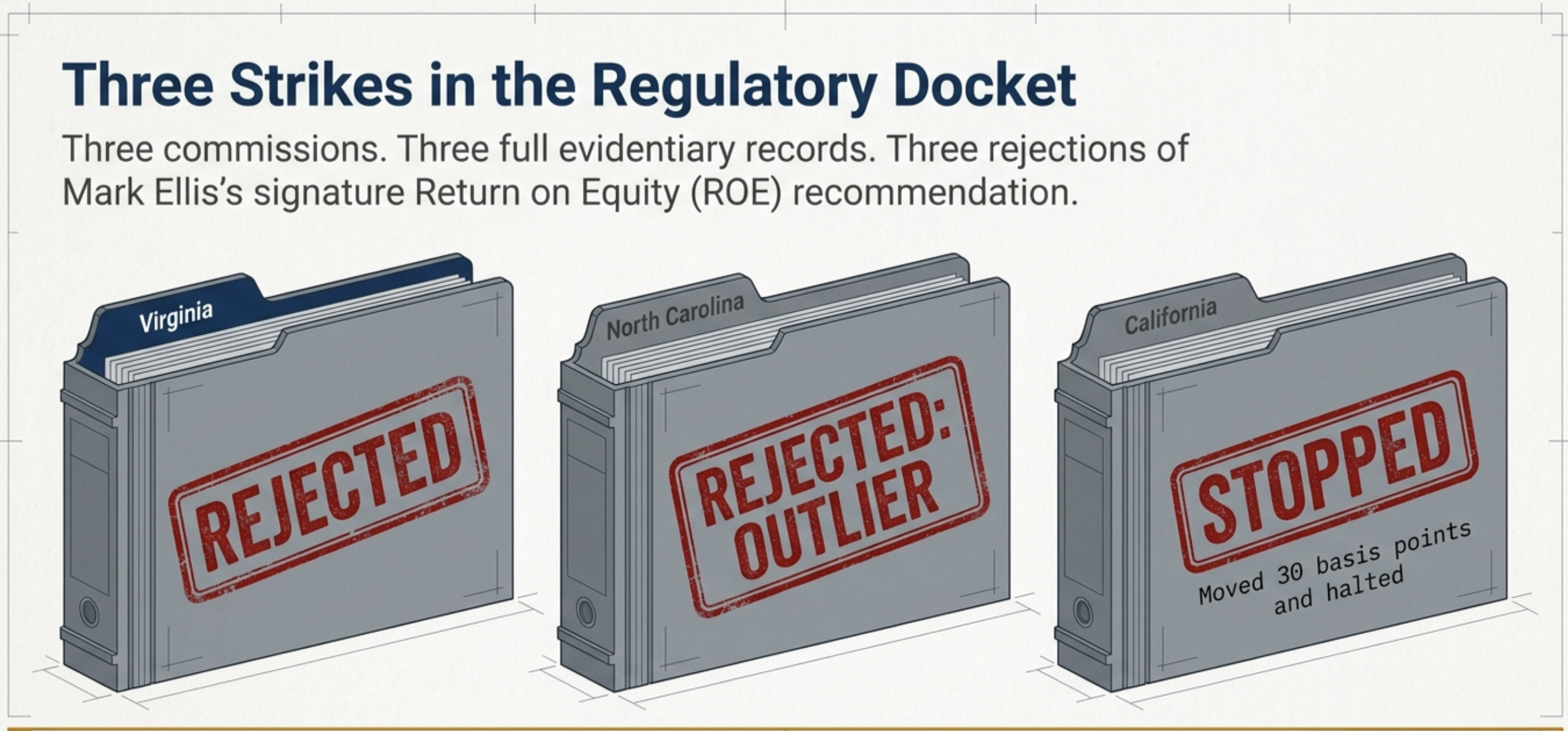
The docket keeps saying no. Virginia rejected Mark Ellis's ROE recommendation. North Carolina called it an outlier. California moved 30 basis points in his direction and stopped. Three commissions, three full evidentiary records, three rejections of his signature number.
So the fight moved. Not out of the building — down the hall, from the regulatory docket to the statehouse floor. If a commission won't set your preferred ROE case by case, you can try to get a legislature to set it for everyone, permanently, by formula. That's exactly what's happening right now in Pennsylvania and New York, and it's the real story this series has been building toward.
What these bills actually do
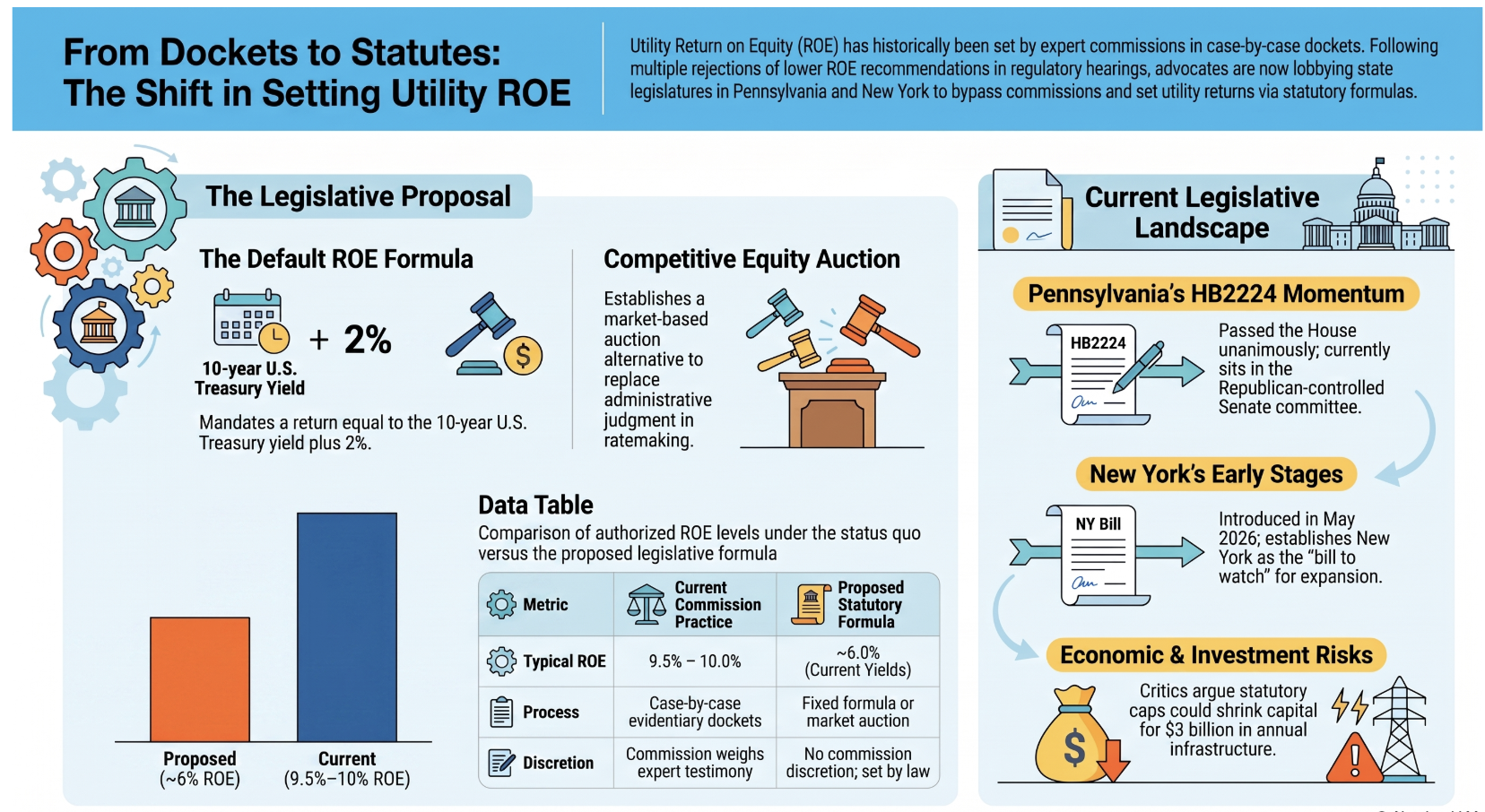
Both bills do the same two things, using nearly identical language.
A default ROE formula. Instead of a commission weighing expert testimony case by case, the bills set a default authorized return on equity equal to the 10-year U.S. Treasury bond yield plus two percentage points. Today, that lands somewhere in the mid-6% range — well below the 9.5% to 10% ROEs commissions are actually authorizing in real rate cases, and squarely inside the 5.5% to 6.5% range Ellis has been recommending in testimony for years.
A competitive equity auction. As an alternative to the formula, both bills create a mechanism where a utility's cost of equity gets set through a market auction rather than administrative judgment — the same "Competitive Direct Equity" concept Ellis has spent years promoting through his own platform, transplanted directly into statutory text.
If you read the Ratemaking 101 piece, you already know why this matters. Every rate case today runs through a case-by-case evidentiary process — testimony, cross-examination, a full record, a commission weighing competing experts. These bills would replace that process, for ROE specifically, with a number set in advance by law. No docket. No expert witnesses arguing the merits. No commission discretion. Just a formula.
Pennsylvania: how far it’s gotten
Pennsylvania's version, House Bill 2224, is the more advanced of the two, and it didn't come out of nowhere.
In early 2026, PECO — Philadelphia's largest electric and gas utility — posted a third-quarter authorized return on equity of 13.1%. The company then filed a new rate case seeking a 12.5% electricity increase and an 11.4% gas increase, with a requested ROE of 10.95%. The filing triggered enough public backlash, and pressure from Governor Josh Shapiro, that PECO withdrew it.
That's the backdrop state Rep. Elizabeth Fiedler (D-Philadelphia), chair of the House Energy Committee, was working against when she introduced HB2224. Her framing has been direct: regular ratepayers don't have savings accounts earning 10% or 13%, so utilities shouldn't either.
The bill cleared committee 17-9 in June 2026 — with a few Republican votes cast, by at least one member's own account, mainly to move it out of committee rather than as an endorsement — and then passed the full House unanimously.
It's currently sitting in the state Senate Consumer Protection & Professional Licensure Committee. That's a meaningfully different environment than the House it just cleared: Pennsylvania's Senate is Republican-controlled, and unanimous House passage doesn't tell you much about what happens next in a chamber with different incentives and a different majority.
The Ellis connection, made explicit
Here's where this series' throughline gets concrete rather than inferential.
A detailed, 19-page FAQ document walking through exactly how HB2224's competitive equity auction mechanism would work — bidder qualification, private placement disclosure, how a PECO auction result would flow through to parent company Exelon's earnings — is hosted directly on marketclear.org. That's Ellis's own platform, the same one built to promote Competitive Direct Equity as a commercial product.
This isn't AELP publishing sympathetic commentary about a bill somewhere in its orbit. This is Mark Ellis's own site actively authoring technical explainer material defending the mechanics of a specific, live piece of Pennsylvania legislation. The idea that lost three times running in front of utility commissions is now being explained, defended, and promoted, in granular procedural detail, for the audience that gets to bypass those commissions entirely: state legislators.
Who's fighting it
The opposition is organized and explicit about the stakes.
The Pennsylvania Chamber of Business and Industry sent a formal memo to the House Consumer Protection Committee before the June vote, urging members to oppose the bill. Its argument: Pennsylvania utilities collectively invest more than $3 billion a year in infrastructure, supporting more than 15,000 direct jobs and tens of thousands more indirectly. A statutory ROE cap, the Chamber argues, would shrink the capital available for exactly the grid investment ratepayers need.
The memo goes further, citing Wall Street analyst commentary from spring 2026 warning that policy uncertainty around a potential ROE cap was already raising utilities' cost of capital in Pennsylvania — before the bill had even passed anything. The argument mirrors a point utility finance experts have made about Ellis's underlying theory generally: financing costs that rise because of policy risk get paid by ratepayers eventually, not absorbed by shareholders.
The Chamber's closing ask wasn't a flat rejection of reform — it was a request to slow down and work through the existing PUC process rather than lock a number into statute. That's a notably similar message to the one this series' first piece made about the value of the case-by-case evidentiary process generally.
New York: earlier and slower
New York's version is worth covering, but it's important not to overstate where it stands. Assembly Bill A11197, the "Fair Authorized Investment Returns Act," was introduced by Assemblymember Sarahana Shrestha on May 1, 2026, and referred to the Corporations, Authorities and Commissions Committee. A Senate companion, S10424, was introduced two weeks later by Senator Mayer and referred to the Energy and Telecommunications Committee.
Both use the identical mechanism — Treasury plus 200 basis points, with a competitive auction alternative. Neither has had a committee vote. Neither has moved to the floor of either chamber. This is early-stage legislative interest, not legislative momentum — a meaningfully different place than Pennsylvania's bill, which has already cleared an entire chamber unanimously.
That gap matters for anyone tracking this closely. Pennsylvania is the test case. New York is the bill to watch for whether the model spreads.
Why this matters more than any single docket
Step back and the shape of the whole series comes into focus. Piece one explained how a rate case actually works — the evidentiary process, the parties in the room, the reason ROE gets litigated the way it does. Piece two showed that process working exactly as designed against Mark Ellis's specific numbers: heard, tested, and rejected, three times, on the merits.
This piece is the reason that record of rejection doesn't settle anything. A losing argument in front of a commission doesn't have to stay lost. It can be rewritten as a statute, introduced in a legislature, and — if it passes — applied to every utility in the state without another docket, another expert witness, or another evidentiary record ever weighing in again.
That's not a hypothetical risk. It's a bill that already passed one chamber unanimously, built around a mechanism the same person promoting it in front of commissions is now explaining directly to lawmakers. The commission process rejected this idea on the merits. The question this series leaves open is whether a legislature will get the chance to adopt it anyway.
Thank you for reading. Got a news tip? Want to see an issue covered? Reach out to us on our Contact page.