He calls himself the insider telling the truth. Regulators call his numbers wrong — every single time.
This article is the second in a three-part series on the utilities industry. Last week we covered the basics of ratemaking. Today, we dive into a real-life example of a battle taking place before utility commissions. The electric grid needs updating, bills are going up, and grid security is becoming crucial — that’s why we’re covering this.
Utility bills are climbing. Ratepayers are angry. And a new figure has emerged on the intervenor circuit to channel that anger: Mark Ellis.
Mark Ellis is an independent consultant, expert witness, and the Senior Fellow for Utilities at the American Economic Liberties Project (AELP). He shows up in rate case after rate case with the same pitch: utilities are over-earning, and regulators need to cut their returns sharply.
He's articulate, well-credentialed, and media-effective. He's helped push utility affordability into a national conversation about the cost of equity.
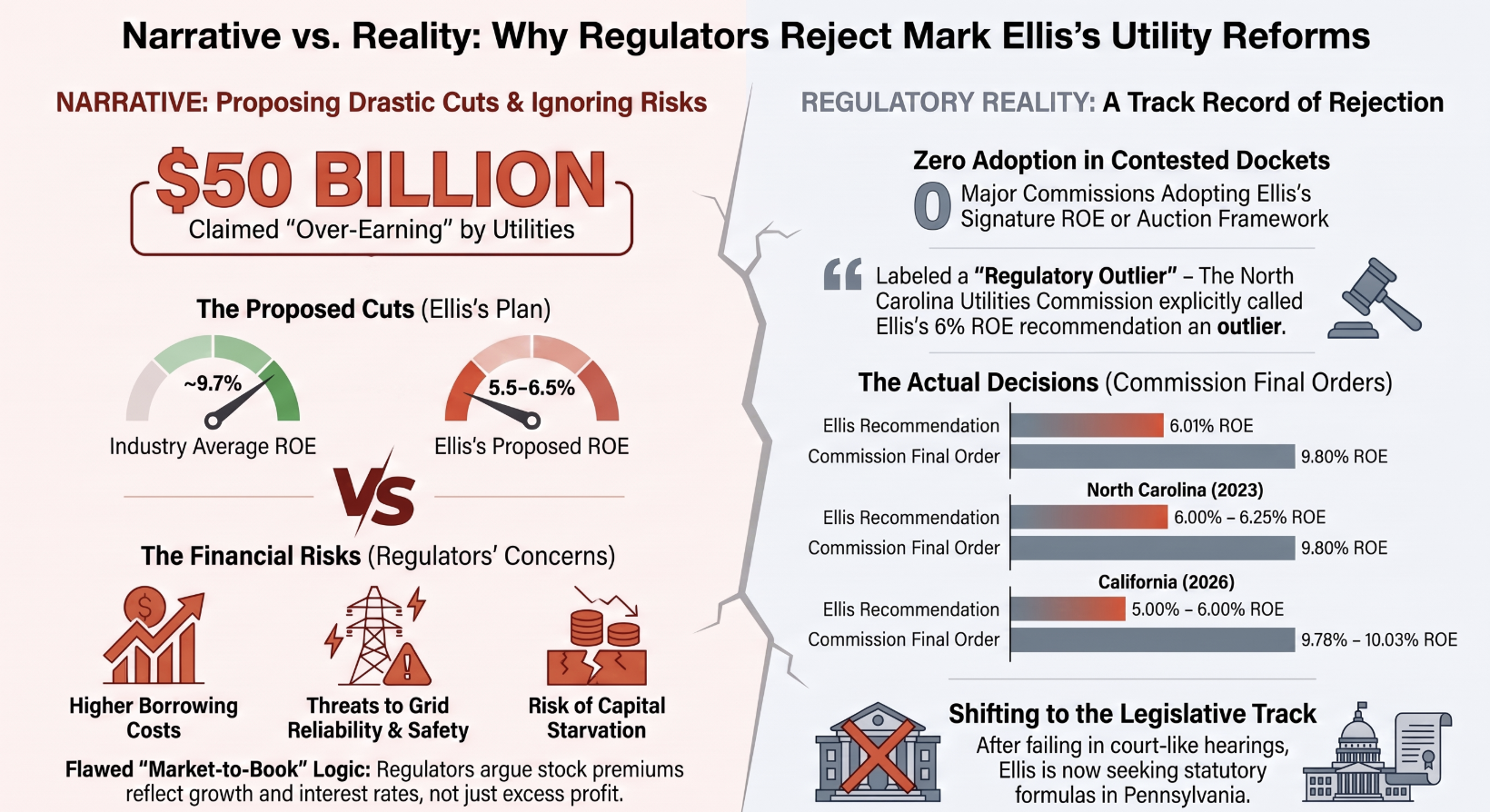
Here's the problem. Every time a commission actually rules on his numbers, they reject them. Not trim them. Reject them. Mark Ellis has built a career on a message that sounds compelling and a track record that says otherwise. This article breaks down who he is, what he argues, and why the regulators closest to the evidence keep saying no — and where his campaign is actually gaining ground.
Mark Ellis: insider background
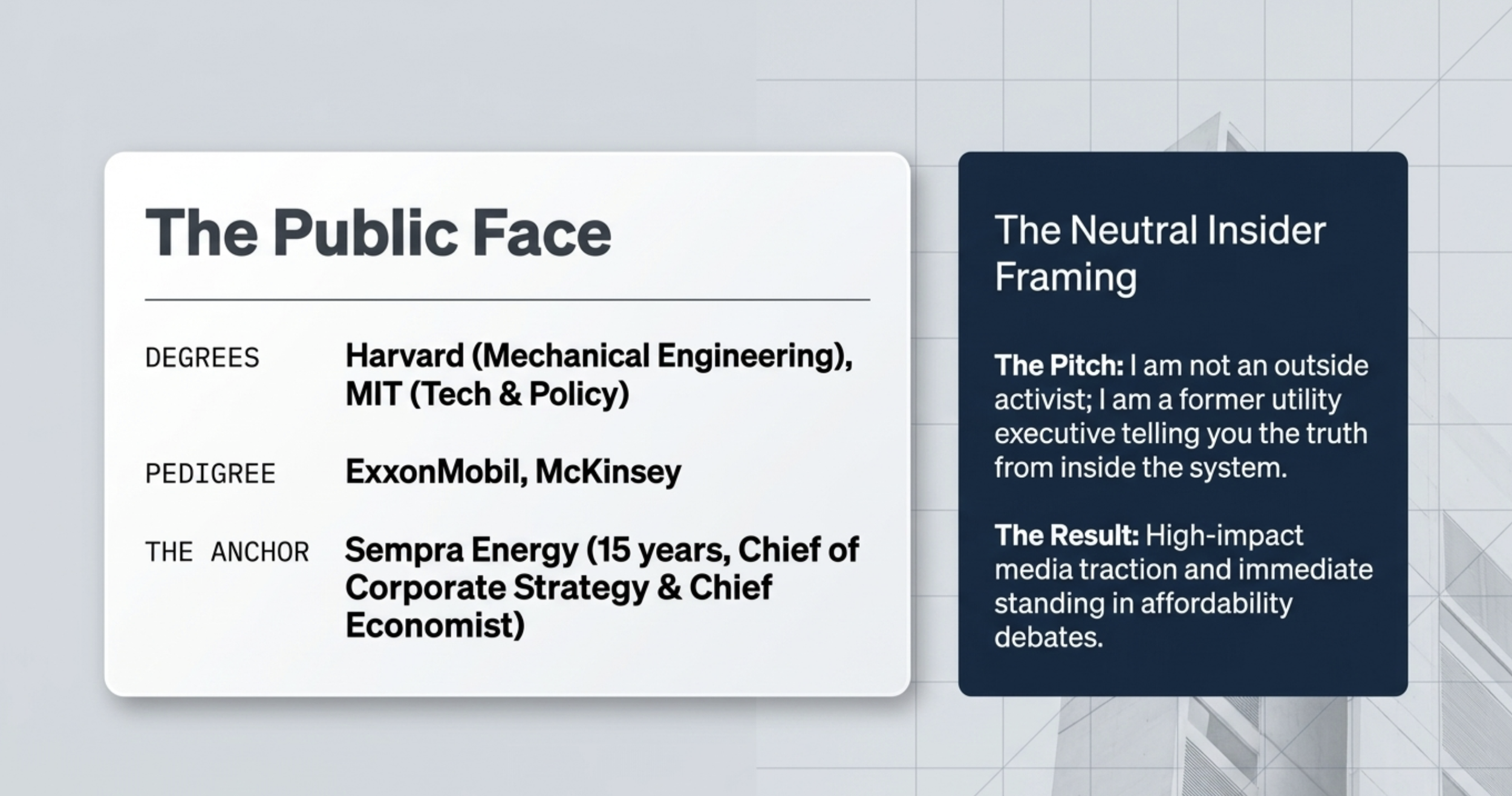
Mark Ellis brings real credentials to the table. A mechanical engineering degree from Harvard. A master's in technology and policy from MIT. A career that runs through Southern California Edison, ExxonMobil, and McKinsey.
The centerpiece is Sempra.
Mark Ellis spent fifteen years there, rising to Chief of Corporate Strategy and Chief Economist.
That's the credential he leads with in every filing and every interview.
It lets him say: I'm not an outside activist, I'm a former utility executive telling you the truth from the inside.
Since 2019 he's worked independently, and that insider positioning has become his signature: he differentiates himself from a typical outside consultant by presenting himself as someone who understands utility finance from within the system he's now critiquing.
Here's what that framing leaves out.
Ellis is a salaried Senior Fellow at AELP, a progressive antimonopoly advocacy group.
AELP was launched in February 2020 to advance the "New Brandeis" antimonopoly movement, and it runs issue campaigns across tech, healthcare, pharmacy benefit managers, junk fees, noncompetes, trade, aviation — and, increasingly, investor-owned utilities.
The utilities program is newer than the rest of AELP's portfolio, but it's become a defined, resourced program rather than a side interest.
AELP's roster underscores how far from neutral its bench is. Its Executive Director, Nidhi Hegde, came from the Open Markets Institute and the Omidyar Network — one of AELP's own funders. Founder Sarah Miller previously served as chief of staff to FTC Chair Lina Khan. Senior Adviser Alvaro Bedoya is a former FTC Commissioner and Biden appointee. Senior Adviser Faiz Shakir managed Bernie Sanders's 2020 presidential campaign. Director of Research Matt Stoller came from the Senate Budget Committee. Director of Policy and Advocacy Morgan Harper is a former CFPB adviser and Ohio Democratic Senate candidate. Senior Strategist Phillip Berenbroick worked for Democrat Senator Amy Klobuchar's antitrust panel. The organization's managing editor, Helaine Olen, is a columnist for MSNBC. Ellis is one of only two people on AELP's staff with actual utility-sector experience — the other being Marissa Paslick Gillett, the former chair of Connecticut's utility regulatory authority (PURA), who also now serves as an AELP Senior Fellow.
AELP brands itself non-partisan and takes no corporate money. Its funding instead comes from foundations and megadonors: the Omidyar Network (backed by eBay founder Pierre Omidyar, roughly $230,000 in 2021 and about $250,000 in 2023), Open Society Foundations (backed by George Soros, $500,000 in 2021), the Sandler Foundation ($500,000 in 2022, $1.25 million in 2023), the Ford Foundation ($25,000 in 2024, $250,000 committed for 2025), and Fidelity Charitable, a donor-advised fund that disbursed roughly $1.39 million in 2023 without disclosing the original donor. AELP reported about $4.5 million in total revenue in 2024. It's a compact operation — roughly two dozen staff — with an affiliated advocacy arm called Fight Corporate Monopolies and a trade-focused program called Rethink Trade.
Ellis's compensation and financial interests extend well past his AELP fellowship. He's retained case by case by intervenor and ratepayer groups, and his public statement of qualifications lists a long client roster:
The Utility Reform Network (TURN)
Protect Our Communities Foundation
North Carolina Justice Center
Georgia Interfaith Power and Light
Clean Wisconsin
New Hampshire Department of Energy
Utah Office of Consumer Services
Clean Virginia
That last one is worth a closer look — Clean Virginia was created in 2018 by Michael Bills, a former Goldman Sachs investor, and Sonjia Smith specifically to counter Dominion Energy. Bills and Smith are among Virginia's largest political donors, having contributed more than $2.3 million apiece to state campaigns since 2018.On top of the salaried fellowship and the case retainers, Ellis has a commercial stake in his own proposed fix. He's the promoter of a platform called MarketClear, built around what he calls "Competitive Direct Equity," and he serves as an advisor to the wildfire-technology startup Gridware.
None of this proves his math is wrong — utilities fund their own cost-of-capital witnesses far more heavily, and funding alone doesn't establish analytical error. But it does mean the "neutral insider" framing doesn't survive contact with the facts. He's a compensated advocate with a direct commercial stake in the reform he's promoting, sitting on the bench of a foundation-funded advocacy group whose leadership is drawn almost entirely from Democratic administration alumni and progressive think tanks.
The core arguments: breaking down the "over-earning" claim
First, what is ROE?
Before getting into what Mark Ellis argues, it's worth pausing on the term at the center of the fight: authorized return on equity, or ROE.
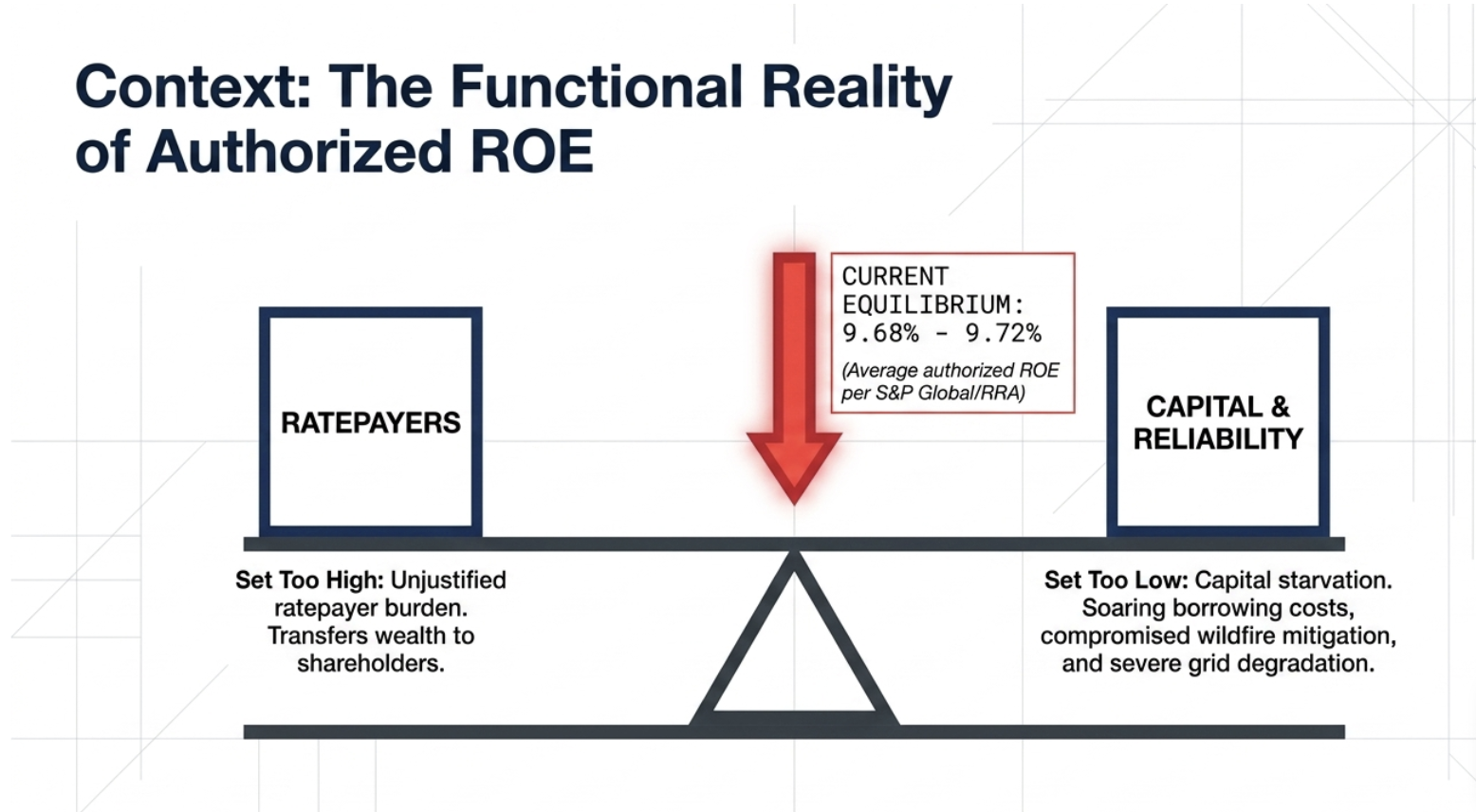
When a utility builds power lines, power plants, or other infrastructure, it pays for that construction partly with debt and partly with equity — investor money. ROE is the legally permitted profit rate regulators allow the utility to earn on that equity-financed share of its investment. It's not a number utilities pick for themselves. Commissions set it, case by case, after weighing testimony from experts on every side.
That single number is a balancing act with real consequences on both ends.
Set it too high, and customers overpay. ROE is one of the biggest single drivers of a monthly utility bill, and an inflated authorized return effectively transfers money from ratepayers to shareholders.
However: set it too low, and the utility struggles to raise capital on reasonable terms. Utilities depend on investor money to fund grid reliability work, capacity growth, and wildfire mitigation. Starve that capital by setting returns too low, and the utility's borrowing costs rise — which, over time, can raise customer costs anyway and leave the grid less reliable, not more affordable.
That's why every general rate case features a real fight over this number, with expert witnesses on both sides. Today, average authorized ROEs for electric and gas utilities sit in the high-9% range — roughly 9.68% to 9.72%, per S&P Global/RRA. Mark Ellis argues that's far above the true market cost of equity and should be cut to roughly 5.5% to 6.5%. That gap — three to four full percentage points — is the entire dispute in miniature.
What Mark Ellis actually argues
Strip away the credentials and the funding, and here's what Ellis actually argues, in four moves.
Move one: utilities over-earn. Ellis contends that authorized ROEs sit well above utilities' true market cost of equity, transferring billions of dollars from ratepayers to shareholders every year. This is the basis for his signature headline figure — that utilities collectively over-earn by roughly $50 billion annually, or about $300 per household.
Move two: market-to-book is the tell. His core evidentiary claim is that utility stocks trade well above book value, and that a market-to-book ratio above 1.0 is itself proof that authorized returns exceed the true cost of capital. His logic: investors wouldn't pay a premium over book value unless the allowed return beat what they actually require.
Move three: the cost of equity is knowable. Ellis treats the cost of equity as a more straightforward, precisely computable number than commissions generally treat it as. He argues the standard financial models used in rate cases — which incorporate significant judgment because the underlying estimate is inherently uncertain — systematically overstate the true figure.
Move four: replace the process with a market. His signature reform proposal, Competitive Direct Equity, would scrap the traditional evidentiary rate case in favor of competitive equity auctions to set authorized returns, on the theory that a market mechanism would reveal the "true" cost of equity more accurately than expert testimony and commission judgment.
The bottom-line ask: while authorized ROEs typically sit near 9.5% to 10% today, Ellis has recommended figures in the 5.5% to 6.5% range across his recent cases — a gap of three to four full percentage points between what he proposes and what utilities currently earn.
It's a clean, quotable story, and it raises questions. Whether authorized ROEs drifted above the true cost of equity during years of historically low interest rates is a legitimate line of inquiry. Market-to-book ratios are a real data point that deserves a substantive answer. Ratepayer affordability is a genuinely pressing concern, and Ellis's insider background gives him a level of standing a typical outside consultant doesn't have.
The weaknesses of Mark Ellis’ arguments
But his argument has real weaknesses that utility finance experts have detailed at length:
Over-reliance on market-to-book. A market-to-book ratio above 1.0 reflects far more than excess ROE — it also captures growth expectations, interest-rate cycles, the value of the regulated franchise itself, and merger-and-acquisition premiums. Treating it as direct proof of over-earning skips over everything else that moves a stock price.
Overstated precision. Ellis treats the cost of equity as easier to pin down than commissions — which weigh extensive records and multiple competing models — generally find it to be. Regulatory judgment exists precisely because the estimate carries real uncertainty.
Downplaying capital access and reliability. His framework gives limited weight to credit quality and the ability to attract capital, at a moment of historic investment need for grid hardening, wildfire mitigation, and load growth. Set a return too low and borrowing costs rise — a cost that ultimately lands back on the customers he says he's protecting.
Company-specific stakes, market-wide evidence. Ellis uses broad, market-wide observations to justify recommendations for individual utilities, even though company-specific risk profiles and jurisdictional circumstances are exactly what the case-by-case evidentiary process is designed to capture.
Mark Ellis’ record of success: zero adoption by regulators
This is the part of the story Mark Ellis doesn't lead with. When his theories are tested against a full evidentiary record — utility witnesses, commission staff, competing experts, cross-examination — commissions engage with his arguments and then decline to adopt them. Every time.
Virginia (SCC / Dominion Energy, 2025). Clean Virginia and Ellis recommended a 6.01% ROE and a 57.8% equity ratio, claiming it would cut Dominion's annual revenue requirement by roughly $470 million. Commission staff recommended 9.80%. Dominion itself argued for 10.40%. The State Corporation Commission's final order authorized 9.80% — siding with staff, not Ellis, and leaving a gap of nearly four full points from his number. This is the cleanest illustration of the pattern: full record, full hearing, and a rejection on the merits.
North Carolina (Utilities Commission / Duke Energy Progress, 2023). Ellis, testifying for the North Carolina Justice Center, recommended approximately 6.0% to 6.25%. The commission authorized 9.80%. Later public testimony in a separate Utah proceeding quotes the North Carolina order directly calling Ellis's recommendation an "outlier."
California (CPUC cost-of-capital proceeding, 2026). Ellis and allied intervenors pushed for his 5% to 6% framework. The commission's final decision cut authorized ROEs by only about 30 basis points, setting individual utility ROEs at 9.78%, 9.93%, 9.98%, and 10.03% — all still close to 10%, nowhere near his recommendation. Directionally in his favor, but a rounding error compared to what he asked for.
Arizona (ACC / Tucson Electric Power, 2026). Ellis was retained by the Arizona Attorney General's office and is pressing a lower-ROE approach. Public reporting indicates closing arguments were due in July 2026, with a requested effective date in September. No final commission order has been issued as of this writing — still pending, still unresolved.
Zero for three, with one pending, across the major dockets reviewed. And the broader market data backs up the pattern: S&P Global/RRA reported that average authorized ROEs across the industry in the first half of 2025 stood at 9.68% for electric utilities and 9.72% for gas utilities — essentially unmoved from where they've sat for years, nowhere close to Ellis's target range.
Additional cost-of-capital dockets round out his broader portfolio of engagements — Georgia Power, Wisconsin Electric, New Hampshire's Aquarion, and Utah's Rocky Mountain Power — though the docket-by-docket outcomes in those cases weren't part of the detailed review here.
The real battlefield
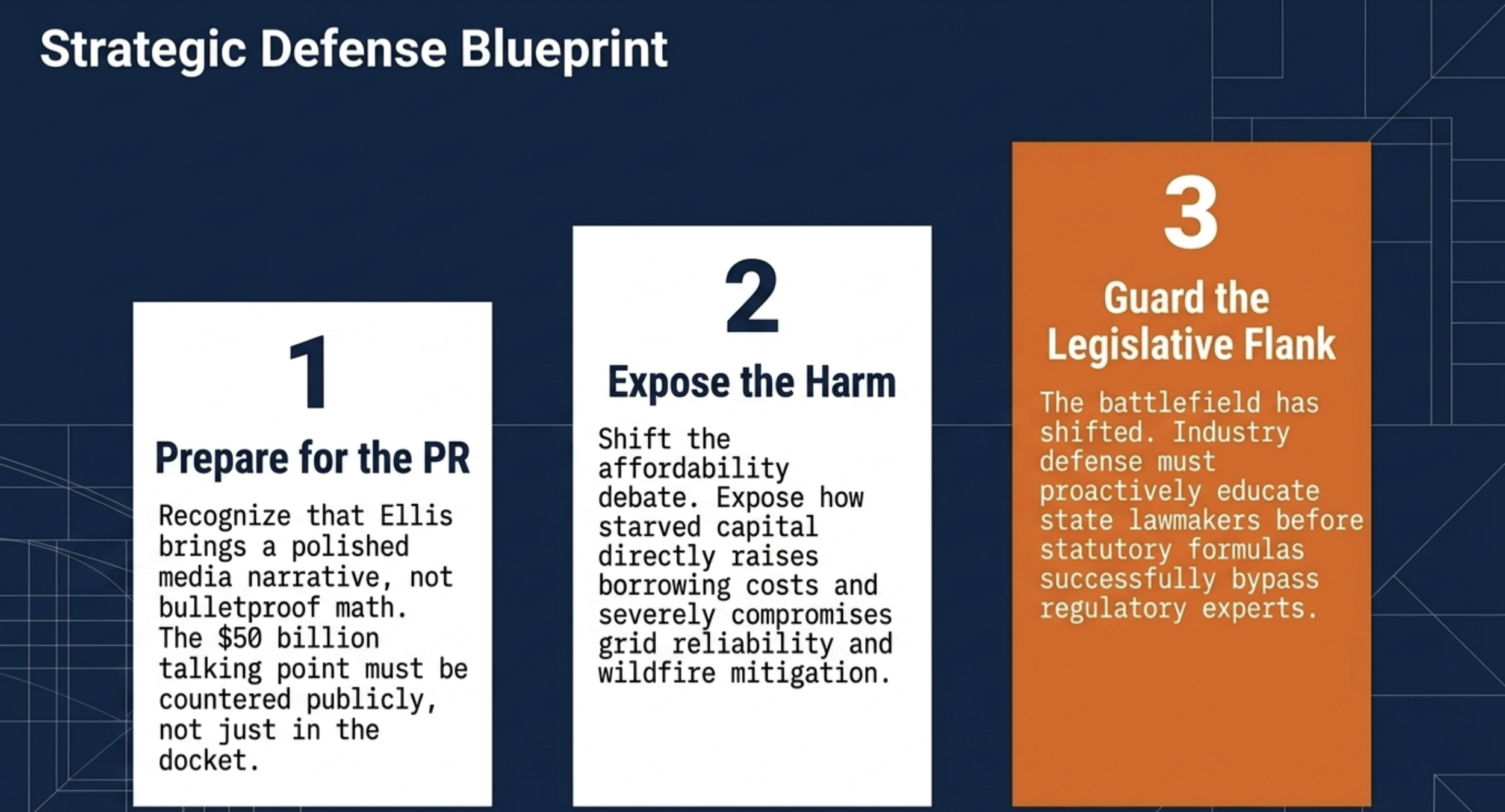
Here's the honest assessment. Mark Ellis's win rate in front of utility commissions weighing his signature ROE and auction framework against a full evidentiary record is zero. But his win rate at generating narrative and political traction is a very different story. The $50 billion headline travels. The insider credential travels. And that narrative success is exactly why the fight is shifting.
AELP and Ellis are increasingly working the legislative track rather than the docket.
Pennsylvania's HB2224 — built around a default ROE formula tied to the 10-year Treasury rate plus 200 basis points, alongside competitive equity auction concepts — passed the state House 202-0 and has moved to the Senate.
New York's companion bill, A11197, has been introduced.
Both are legislative proposals, not commission orders, but they represent exactly the risk regulators and utilities should be watching: a statutory formula that locks in Ellis's framework by law, bypassing the case-by-case evidentiary process that has rejected his numbers three times running.
That's the real battlefield now. Not another rate case. A statute that sets returns by formula before anyone gets to test it against a full record — the way commissions in Virginia, North Carolina, and California already have, and found it wanting every time.
Further reading
“A Former California Utility Exec Explains Why Your Electricity Bills Are So High” (Inside Climate News)
Mark Ellis bio (The Federalist Society)
“Ratemaking 101: How your utility bill actually gets set” (The Vanguard Record)