The most consequential trial you've never heard of happens in your state, every year, over your electric bill.
This article is the first in a three-part series on the utilities industry. The electric grid needs updating, bills are going up, and grid security is becoming crucial — that’s why we’re covering this.
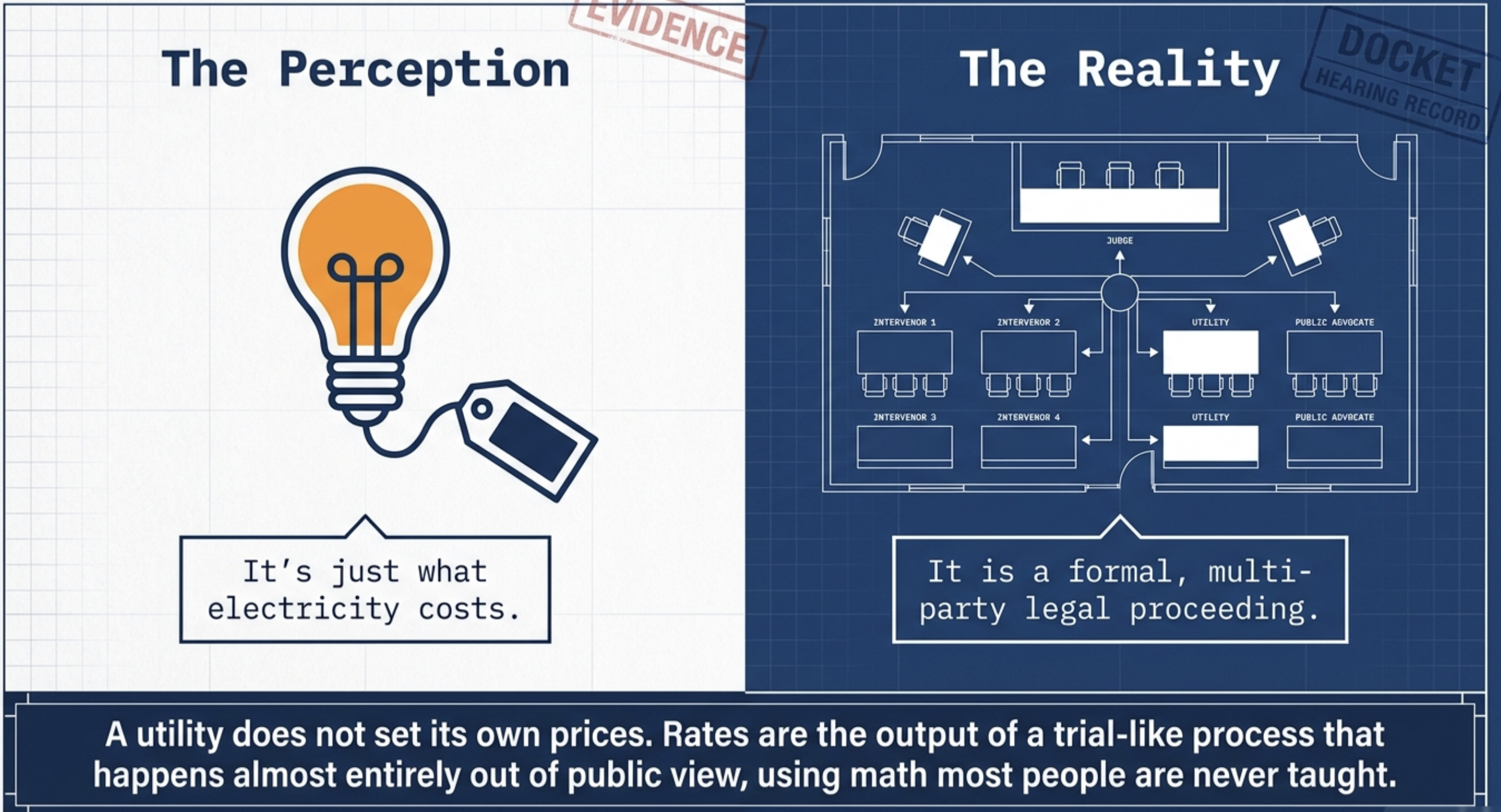
Most people think their utility bill is just "what electricity costs." It isn't. It's the output of a formal legal proceeding — closer to a courtroom trial than a price tag — that almost nobody outside the industry ever watches happen.
That proceeding is called a general rate case.
It runs in nearly every state, nearly every year, for nearly every electric, gas, and water utility in the country.
It sets how much you pay.
It also sets whether the grid you depend on gets the investment it needs.
And it happens almost entirely out of public view, decided by people whose names you probably don't know, using math you were never taught.
This is the first piece in a three-part series on the utilities industry. Before we get into any specific fight over any specific number, it's worth understanding the machine those fights happen inside. Once you see how a rate case actually works, everything else in this series will make a lot more sense.
What a general rate case actually is
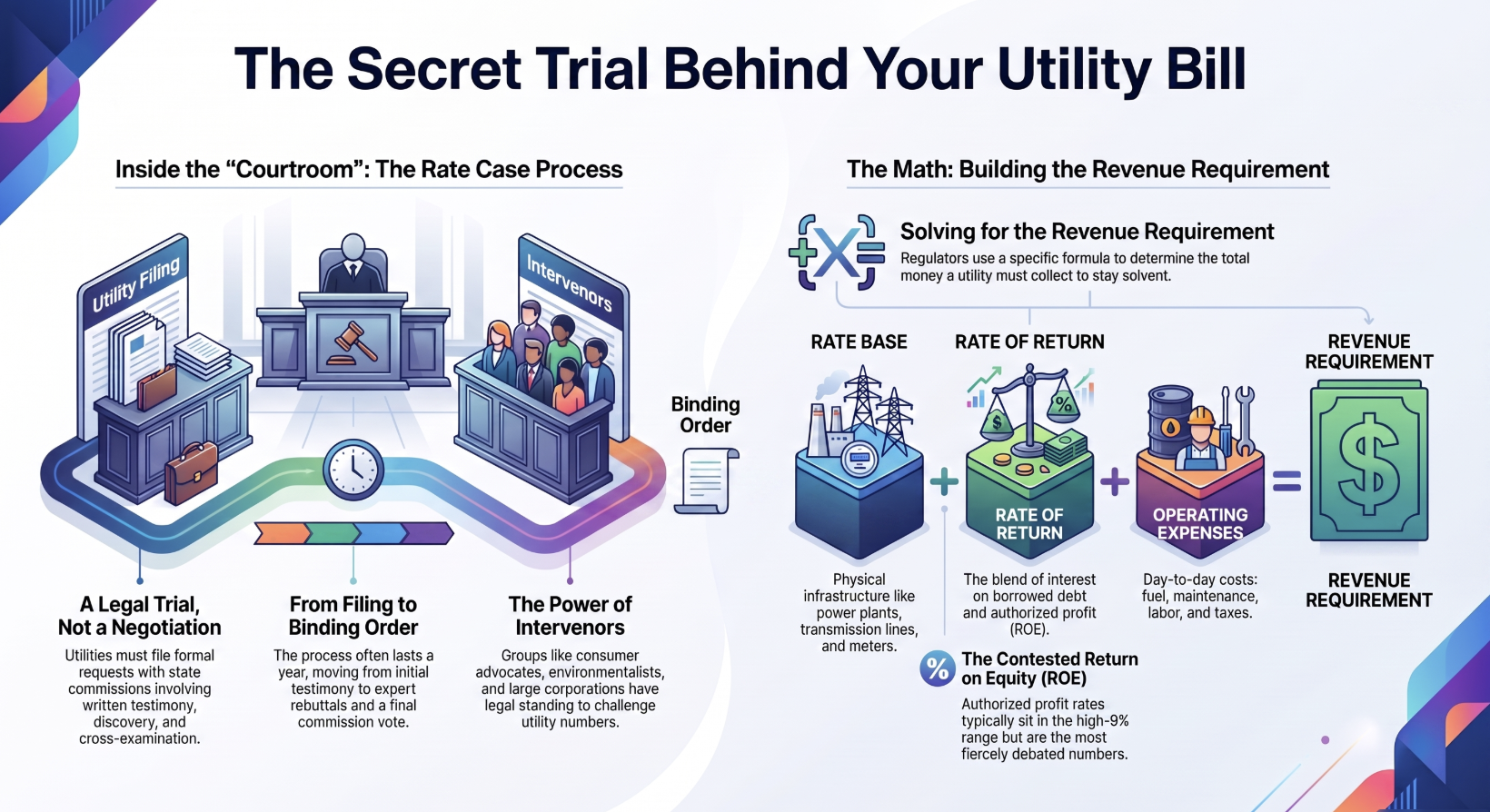
A utility doesn't set its own prices. It files a request — a general rate case — with a state regulatory body, usually called a public utility commission (PUC), public service commission (PSC), or in some states, a corporation commission. That filing kicks off a formal proceeding: written testimony, discovery, cross-examination, expert witnesses, and eventually a binding order.
It is not a negotiation between a company and its customers. It's closer to a trial, with the utility as the party bringing the case and everyone else — commission staff, consumer advocates, industrial customers, environmental groups — as parties responding to it.
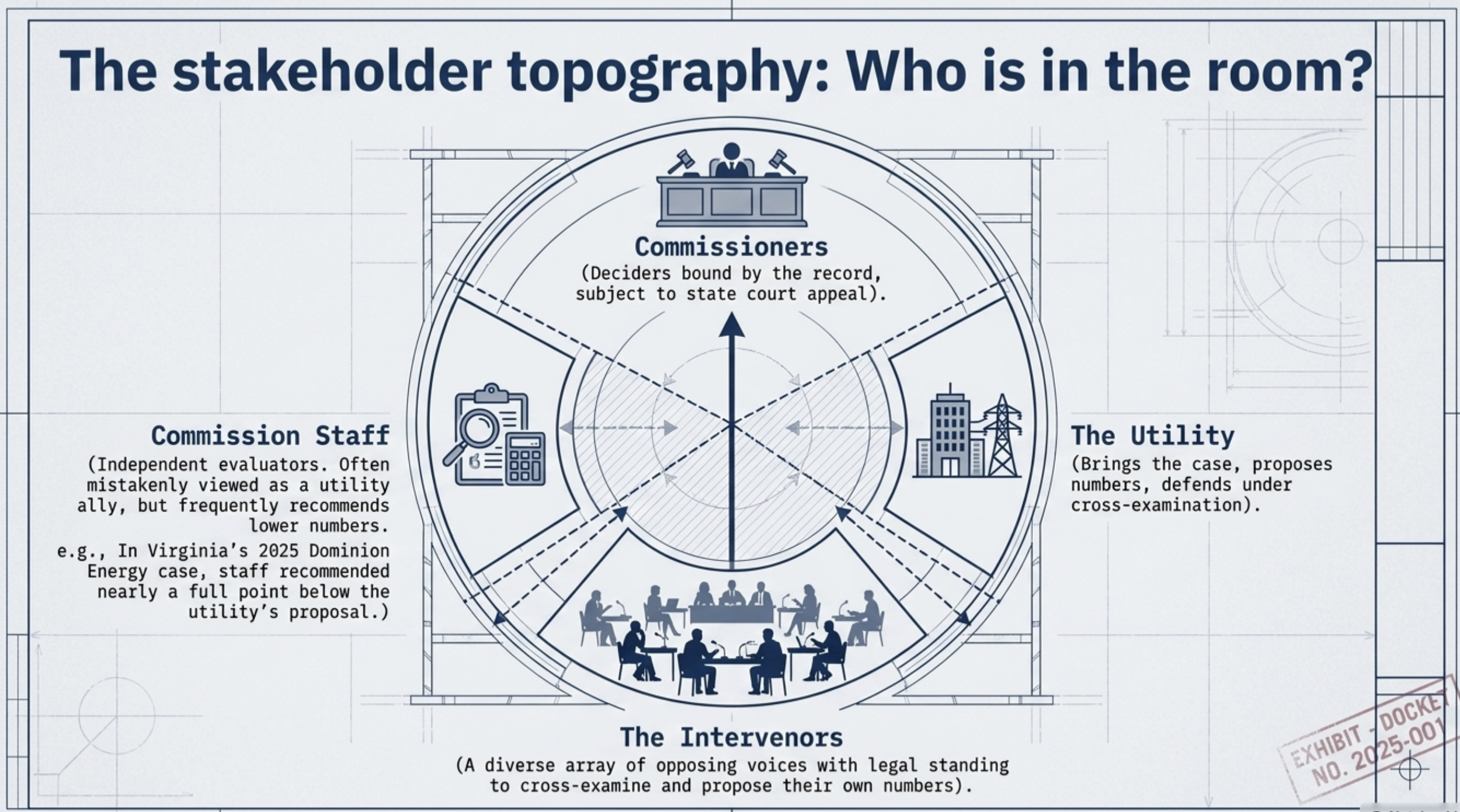
The commissioners act something like judges: they don't work for the utility, and they're bound to decide based on the evidentiary record in front of them, not on public opinion or press coverage.
A live example: in November 2024, NSP-Minnesota (an Xcel Energy subsidiary) filed an electric rate case with the Minnesota Public Utilities Commission, based on a requested 10.3% ROE and a $13.2 billion rate base. Eight separate parties — including the Minnesota Department of Commerce, the state Attorney General's office, Xcel's large industrial customers, the Citizens Utility Board, and even Walmart — filed testimony responding to that request.
That's what a fully contested rate case looks like: one company, eight independent voices, all fighting over the same set of numbers.
The building blocks of a rate
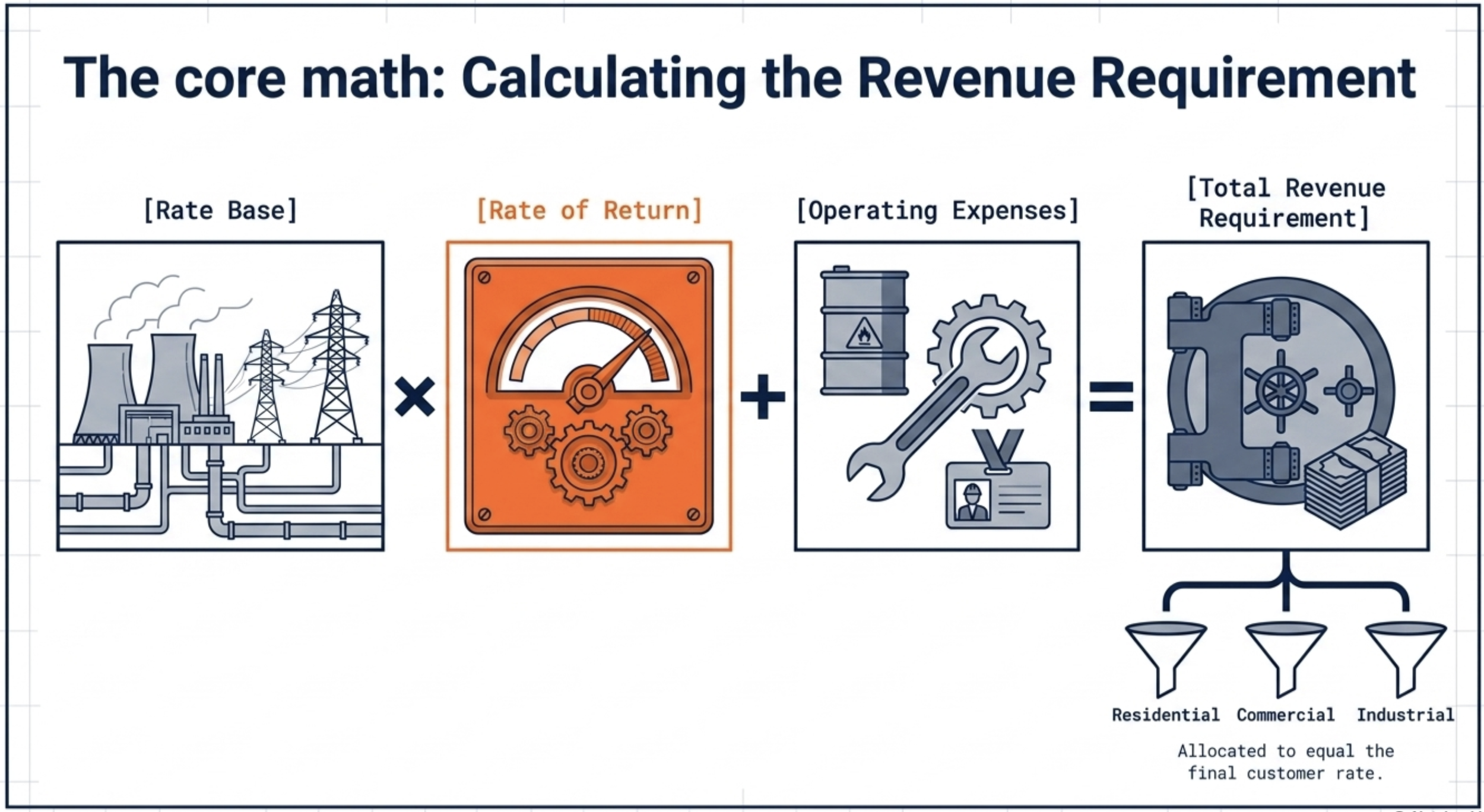
Underneath the legal process is a fairly simple formula. Every rate case, at its core, is answering one question: How much revenue does this utility need to collect from customers to cover its costs and earn a fair return?
That revenue requirement comes from three pieces:
RATE BASE. The value of the utility's invested infrastructure — power plants, transmission lines, pipes, meters — the physical stuff that delivers your electricity, gas, or water. NSP-Minnesota's rate base in its 2024 case was over $13 billion and climbing.
RATE OF RETURN. What the utility is allowed to earn on that rate base, blending its cost of debt (what it pays to borrow) with its authorized return on equity, or ROE — the profit rate regulators let it earn on the equity-financed share of that investment. ROE is usually the most contested number in the whole case, because it's the one with the most room for expert disagreement (we will share a case example in the next article in this series).
Authorized ROEs today typically sit in the high-9% range nationally, though specific cases run from the low 9s (Xcel's Colorado gas settlement: 9.2%) to over 10% (NSP-Minnesota's requested 10.3%).
OPERATING EXPENSES. Everything it costs to actually run the utility day to day — fuel, maintenance, labor, taxes.
Add those together, and you get the total revenue requirement — the number the commission ultimately approves or adjusts. Divide that among customer classes (residential, commercial, industrial), and you get your rate.
Who's in the room
A rate case isn't just the utility talking to the regulator. It's a room full of parties, each with a formal legal status called "intervenor," each entitled to file testimony, cross-examine witnesses, and argue for their position.
The utility. Files the case, proposes the numbers, defends them under cross-examination.
Commission staff. Often mistaken for the utility's ally. In practice, staff frequently recommends numbers well below what the utility requested — in Virginia's 2025 Dominion Energy case, for instance, commission staff's recommended ROE was nearly a full point below what the utility itself proposed.
The state consumer advocate. Many states have a formally designated office — an Attorney General's division, an Office of the People's Counsel, a Citizens Utility Board — whose sole job is representing residential ratepayers in these proceedings.
Intervenors. Anyone else with standing and an interest: industrial customers negotiating their own rate class, environmental groups pushing for clean energy investment terms, ratepayer advocacy nonprofits, and sometimes, as in the Minnesota case above, a company like Walmart showing up to protect its own bottom line as a large commercial customer.
Every one of these parties can propose its own number. In the NSP-Minnesota case, the Department of Commerce and Xcel's industrial customers each proposed different multimillion-dollar reductions to Xcel's request, largely built on lower ROE recommendations.
How a decision actually gets made
The process typically runs in stages. The utility files direct testimony laying out its request. Intervenors file testimony responding, often with their own expert witnesses (you’ll see an example of this in part 2 of this series) and their own recommended numbers.
The utility gets a chance to file rebuttal testimony. In some states, an administrative law judge reviews the full record and issues a report before the commissioners vote.
Commissioners themselves are usually gubernatorial appointees or elected officials, not judges — but their decisions must be grounded in the evidentiary record, and they're subject to appeal in state court if a party thinks they got it wrong.
Not every case goes the distance. Many settle. In Colorado, Xcel's Public Service Company subsidiary requested a 10.75% ROE for a natural gas rate case in December 2025; by July 2026, PSCo had reached a settlement with commission staff and several other parties landing on 9.2%, with a final decision expected later this year.
Avista's 2024 Oregon case settled even more cleanly — an all-party agreement at a 9.5% ROE, approved and in effect within months.
Other cases go all the way to a contested final order, litigated fully on the record, with the commission choosing among the competing numbers rather than everyone agreeing in advance.
Why almost nobody follows this
Here's the honest reason this process stays invisible: it's slow, technical, and built entirely out of filings, testimony transcripts, and commission dockets. A single rate case can run the better part of a year or more. The numbers move in fractions of a percentage point. Nobody's putting this on the evening news.
That obscurity creates an opening.
When a process is this hard to follow, a clear headline number and a sympathetic narrative can travel much further, much faster, than the actual evidentiary record ever does — and can shape public and legislative opinion long before, or entirely apart from, whatever a commission eventually decides on the merits.
That gap between narrative and record is exactly the terrain the rest of this series explores.
Why it’s worth understanding anyway
This obscure, procedural, jargon-heavy process is quietly one of the more consequential things state government does.
It sets what you pay every month.
It determines whether utilities can raise the capital to harden the grid, prevent wildfires, and keep the lights on through the next storm.
Every number in it is contested by design, weighed by people whose job is to balance affordability against reliability, and decided in the open — even if almost nobody's watching.
Understanding how the machine works is the first step to understanding who's trying to move it, and how. That's where we're headed next.
Further reading
How Are Utility Rates Determined? (Your Utilities Hub) (YouTube video)
Ratemaking Fundamentals Fact Sheet (Synapse Energy)
The Four Key Steps to Understanding Utility Rates (Enerdynamics)
Understanding How the CPUC Processes a General Rate Case (California Public Utilities Commission)