China's "Social Credit System" is real — just not the dystopia you've seen in the movies
The truth is more complicated, more bureaucratic, and in some ways more alarming than a single all-seeing score.
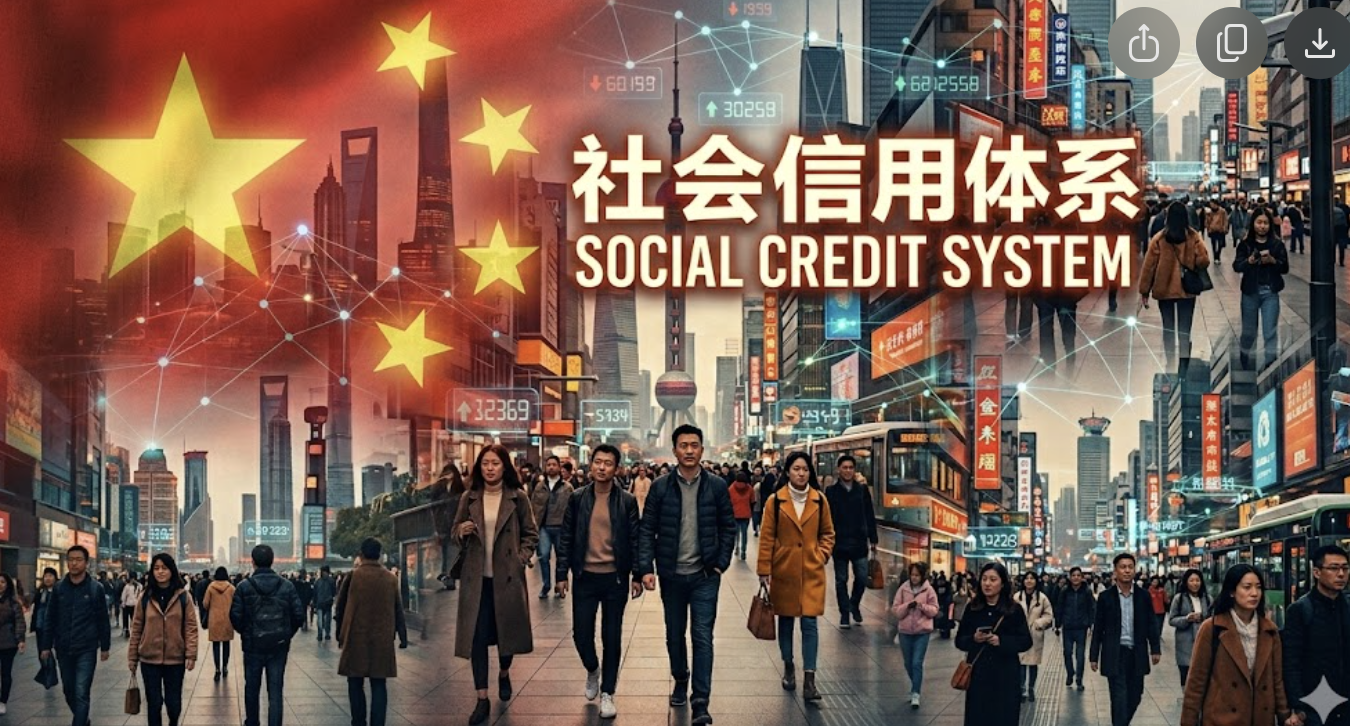
By Shawn Geddes
You've seen the headlines. Maybe you've seen the Black Mirror episode.
China's Social Credit System — the supposed all-knowing algorithm that tracks every citizen's behavior and assigns them a score that determines their fate — has become one of the most-cited examples of authoritarian tech overreach in modern political discourse.
There's just one problem: that version largely doesn't exist.
What does exist is more complicated. And in some ways, more instructive.
It started with markets, not surveillance
The modern Social Credit System didn't emerge from some Orwellian master plan. It grew out of a practical problem. In the 1990s and early 2000s, China's rapidly marketizing economy had almost no reliable credit infrastructure.
Businesses couldn't verify partners.
Courts couldn't enforce judgments.
Fraud was everywhere.
In 2014, the State Council issued the Planning Outline for the Construction of a Social Credit System (2014–2020). The pitch was simple — build a comprehensive architecture to assess "trustworthiness" across government agencies, businesses, and individuals. The official slogan: "Keeping trust is glorious and breaking trust is disgraceful."
The goal was full national rollout by 2020. What actually materialized was a patchwork.
Lists, not scores
Here's what most Western coverage gets wrong. There is no single, unified, real-time citizen score. No central algorithm. No one number attached to every Chinese person that ticks up when they volunteer and drops when they jaywalk.
What exists is a network of blacklists and redlists — operated across central government agencies, sectoral regulators, and local city pilots.
Courts handle judgment defaulters.
Tax authorities track arrears and fraud.
Environmental and transport regulators maintain their own records.
These systems are interconnected but not unified.
Government agencies sign joint-enforcement agreements. If one agency blacklists you, others apply corresponding restrictions in their own domains. It creates a web of secondary consequences rather than a single score.
Some localities experimented further — point-based personal scoring systems, some starting at 1,000 points with ranges from 600 to 1,300. Good behavior adds points. Bad behavior subtracts.
A few cities even built gamified apps around the concept. But these are local experiments, not national policy. Many have been scaled back.
Commercial platforms like Ant Financial's Sesame Credit exist separately. They're opt-in. They're company-run. They interact with state data but are not the government system.
The data machine behind it
The system draws from a wide range of administrative sources: court verdicts and enforcement records, tax payment histories, licensing and inspection results, environmental and safety violations, and customs data. That information feeds into national and provincial platforms where regulators — and sometimes the public — can query an entity's compliance record.
The court system maintains a national online list of "discredited" judgment defaulters. Banks can access it. Other agencies can access it. It functions as a shared enforcement layer across government.
What actually happens when you’re blacklisted
The punishments are real. In some cases, severe.
People who defy court orders can be barred from buying airline tickets or high-speed rail tickets. Executive positions at companies become off-limits. Certain licenses are blocked. Public procurement bids get rejected. Some "discredited person" lists are publicly searchable — displayed on local apps and media.
The reputational damage is built into the architecture.
Companies with repeated regulatory failures face more inspections, slower permit approvals, exclusion from government contracts, and heightened oversight across the board. In an economy where state procurement is a major revenue stream, that's a serious hit.
Local pilots have gone further — adding traffic violations, online disinformation, and minor administrative infractions to blacklist triggers. Implementation is uneven. Some of these experiments have been rolled back. But the potential for scope expansion is real.
One important nuance: many blacklist penalties are time-limited. Resolve the underlying violation, and the restriction can be lifted. Some severe cases, though, carry long-term or lifetime consequences.
The rewards side is real too
The carrot matters as much as the stick.
Landing on a redlist or maintaining a strong compliance record can unlock real benefits.
Banks offer easier loan approvals.
Government agencies reduce inspection frequency and fast-track licensing.
Public procurement bids get priority.
Some local pilots have gone further — deposit-free rentals, utility discounts, even perks on certain services.
For businesses, redlist status can be a genuine competitive advantage. Fewer regulatory headaches. Faster approvals. Better access to government contracts.
Who benefits — and who doesn’t
The system's clearest winners are state regulators and courts. They get a more integrated enforcement toolkit and better cross-agency coordination. Compliant businesses benefit too; they're positioned to leverage redlist status, face less scrutiny, and win more government work.
Sophisticated firms and state agencies are best equipped to work the system in their favor. Ordinary citizens mostly experience it through specific sanctions or modest perks, not a daily granular score touching every part of life.
The clearest losers are people who can't pay. Individuals in precarious economic situations are more likely to fall into court default or tax arrears. They land on blacklists. Recovery gets harder. It becomes a feedback loop: disadvantage compounding disadvantage.
Scholars flag something deeper too. The system's broad framing of "trustworthiness" blurs the line between legal compliance, moral conduct, and political loyalty. That ambiguity opens the door to application against dissidents or politically disfavored groups in ways that are nearly impossible to monitor from outside China.
The bottom line
China's Social Credit System is not the Black Mirror panopticon. It's a bureaucratic governance infrastructure: fragmented, evolving, varying widely by region and sector.
But "not a dystopia" doesn't mean "not worth watching."
The architecture (data aggregation, coordinated multi-agency enforcement, public reputational penalties) represents a model of control that doesn't need a single score to be effective. It just needs enough connected systems, enough shared enforcement agreements, and enough consequences to shape behavior.
That's the real story. Not science fiction. A method. A mentality. An administrative framework still being built, still being contested, and still expanding.
Watch it closely.
Further reading
Assessing China’s “National Model” Social Credit System (Stanford University)
China just announced a new social credit law. Here’s what it means. (MIT Technology Review)
China’s Corporate Social Credit System (Congressional Research Service)
China’s Corporate Social Credit System (PDF) (U.S.-China Economic and Security Review Commission)
China’s social credit score – untangling myth from reality (Mercator Institute for China Studies)
China’s Social Credit System and Information Control Regime (Observer Research Foundation)
Official website (Chinese government)
Planning Outline for the Construction of a Social Credit System (2014-2020) (Stanford University)
The Vanguard Record covers topics most outlets under-explain. If you found this useful, share it.