This article is Part 1 in a four-part series on data centers.
The midterms delivered a clear message
The 2026 midterm elections were a sweep for Democrats, as Americans have now learned. It is indisputable: voters wanted change. American voters rejected President Trump's agenda, especially high food and grocery prices, the war in Iran, perceived corruption by administration officials, and heavy-handed immigration enforcement.
But what else did we learn from the midterms?
Four words: Americans hate data centers.
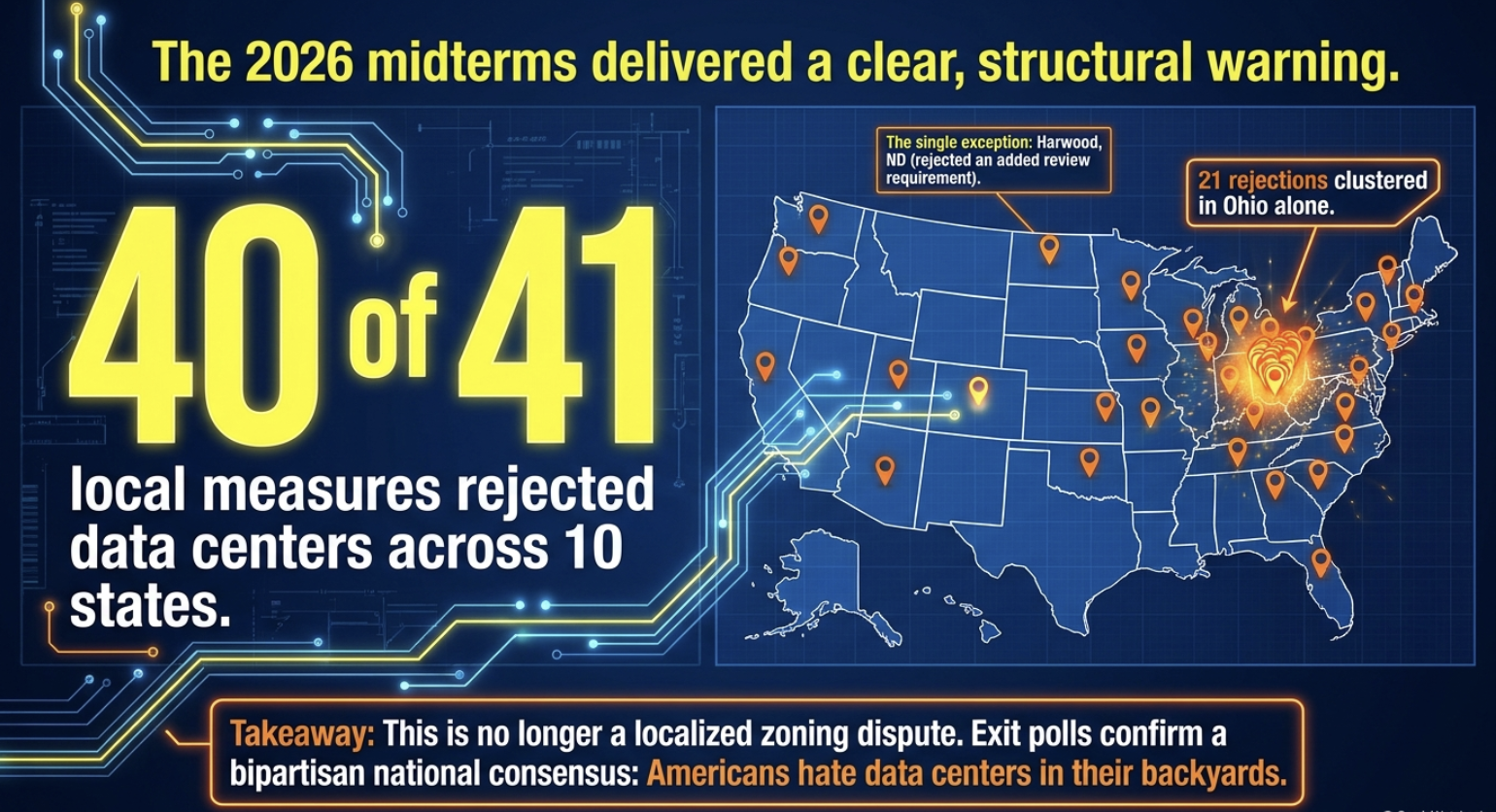
In all but one of 41 local measures across 10 states, voters sided AGAINST data centers, according to a CNBC analysis of Ballotpedia data. Twenty-one of those local measures were in Ohio alone.
The sole exception came in Harwood, North Dakota, where voters rejected an added review requirement for industrial projects that included data centers.
Exit polling showed just how much disdain Americans feel about data centers. Most voters (a large majority) told pollsters they do not want a data center in their own community. A majority of voters said that the issue of AI and data centers were a major factor in deciding how they voted this year.
So what about it? Well, this issue is no longer just a local zoning fight. It is now a national political fact that elected officials, locally and nationally of both parties, must now confront.
How big the power demand has become
In the U.S., electricity has become more expensive in recent years, as most people well know. Electricity is a scarce resource that is subject to the laws of supply and demand.
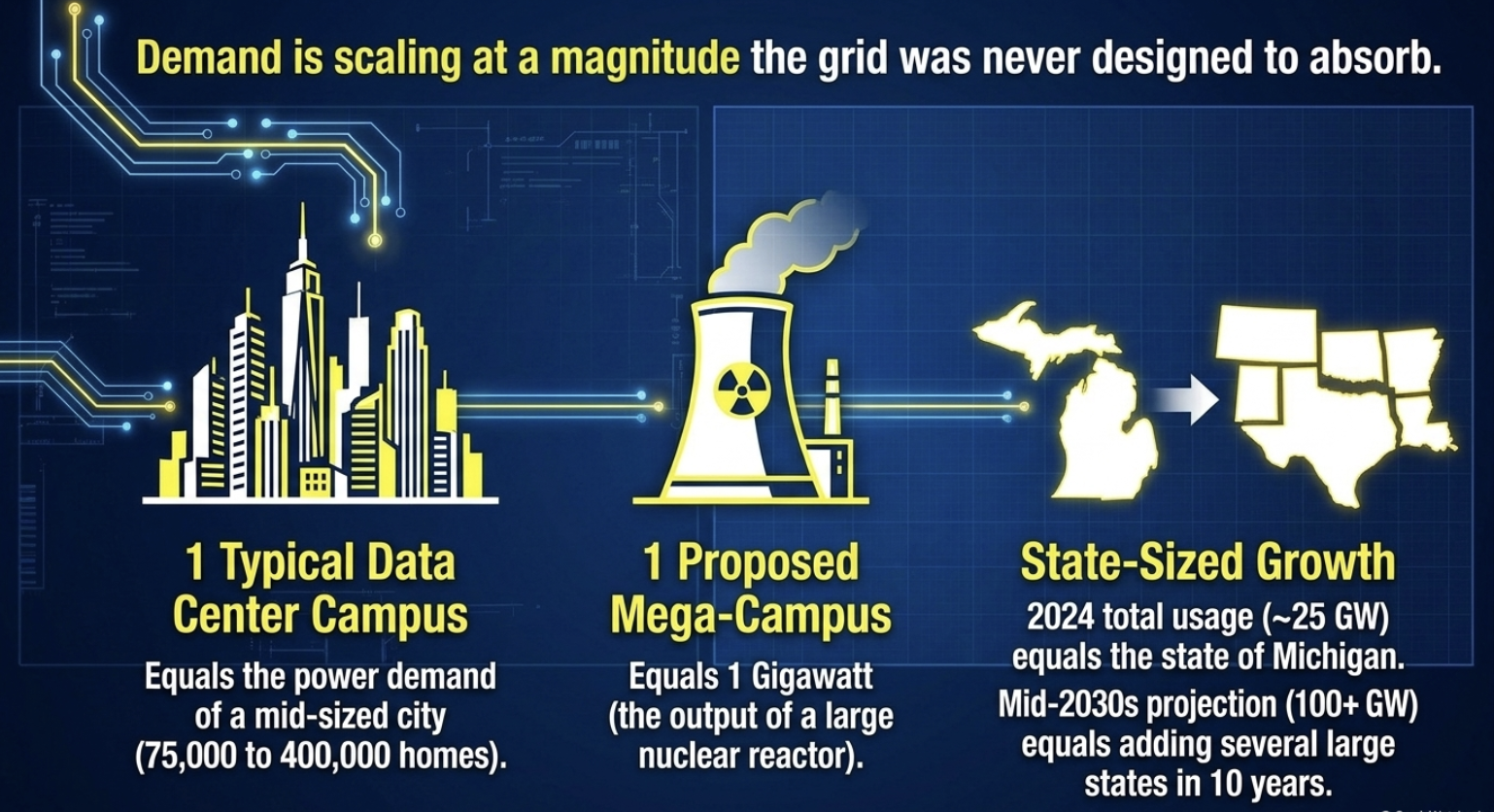
Data centers across America already use up a large share of the nation's electricity. In 2024, they used around 25 gigawatts of power. To put that in perspective, that is almost as much as the entire state of Michigan uses.
Experts predict that that number will double by the end of this decade. By the mid-2030s, forecasters predict that data centers will use 100 GW or more. That is the equivalent of adding electricity demand of several large states in just 10 years' time.
To put it in another perspective, a typical large data center campus uses the equivalent electricity of a mid-sized city of 75,000 to 400,000 homes. Proposed campuses are even bigger, with some aiming for a full gigawatt, equivalent to the output of a large nuclear reactor.
Northern Virginia remains the largest hub; rapid growth in Texas, Ohio, Georgia, and other markets
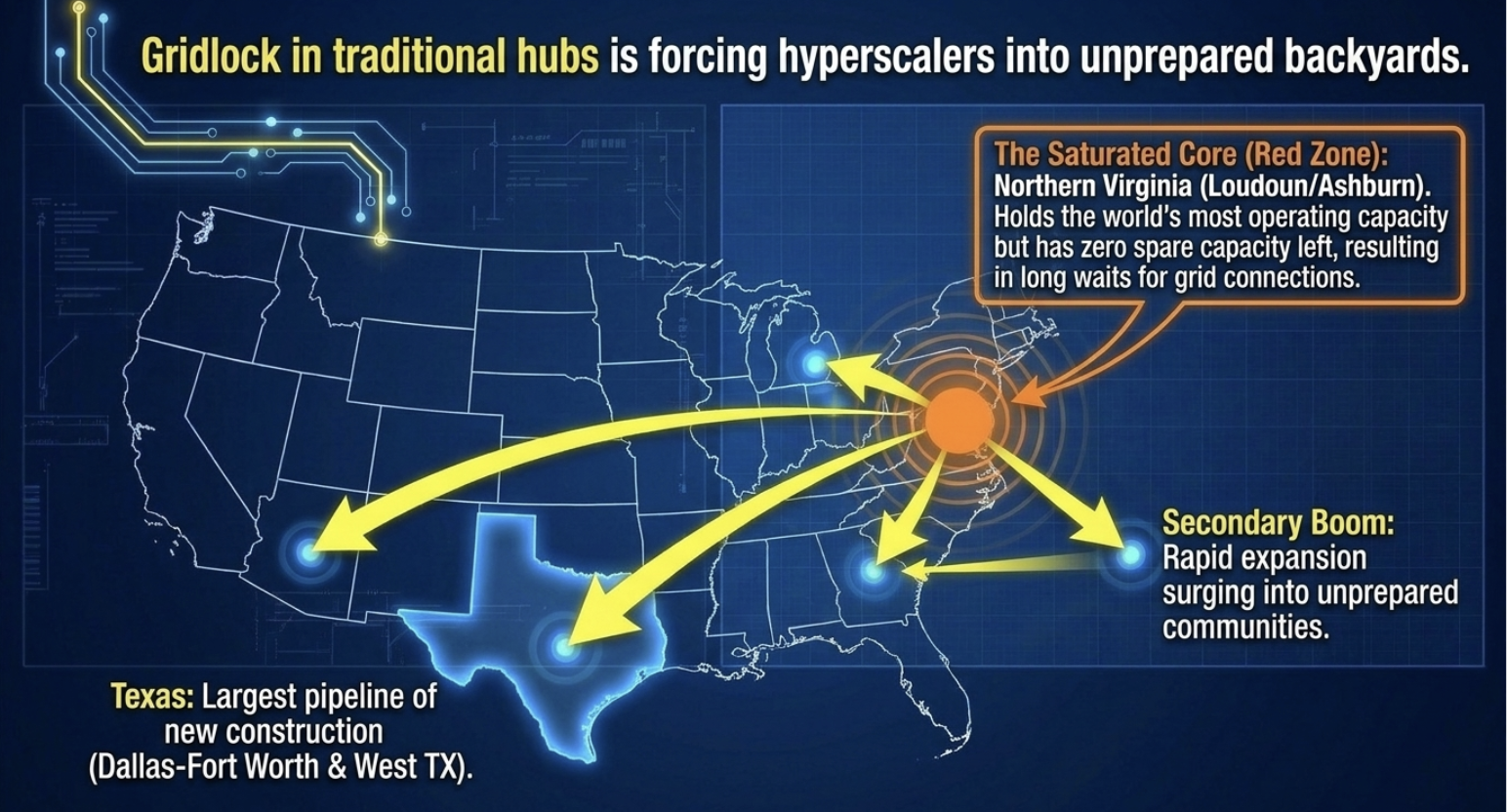
While some people may assume that data centers are popping up all around the country, that is not entirely true. Most of the data centers in the United States are not evenly spread across the map. The largest cluster by far is in Northern Virginia, especially Loudoun County and the area around Ashburn.
The data centers in Northern Virginia hold more operating capacity than any other market in the United States and, by some measures, more than any other place in the world. The attraction to the Northern Virginia area years ago was spurred by its dense network of fiber optics, proximity to internet exchanges, and a history of local tax incentives.
In states where land and power are more readily available, newer growth is occurring. Texas now has the largest pipeline of new construction projects. There are major campuses planned or underway in the Dallas-Fort Worth area and in West Texas. The country is also seeing growth and expansion in Ohio and Georgia, as well as Pennsylvania, Arizona, and the southeastern part of the United States. Northern Virginia has little spare capacity left and faces longer waits for new grid connections, so these markets are opening up. As a result, power demand is becoming more widespread.
Why it is different from past industrial loads
Data centers represent a seismic shift in another way. Let's compare them to factories and industrial plants that the grid has grown up with over the past century. Traditional factories use a lot of power when they are running, typically during the day, but they slow down or shut down at night and on weekends. Data centers, they do not shut down. They run at high power levels around the clock every day of the year. That steady, always-on-demand electricity is what grid operators call a "high capacity factor." Whereas traditional users of electricity fluctuate given the time of day or weather conditions, data centers use a high amount of electricity nonstop.
The other seismic shift is the speed at which demand is increasing, based on the buildout of data centers and how fast it's going. In the past, a new auto plant or a steel mill, for example, would take years to plan and develop. This would give utilities a lot of time to add power plants and power lines. Data centers, on the other hand, are requiring hundreds of new megawatts in just a few years. That combination (a very large size, nearly constant demand, and rapid growth) has put a ton of immediate pressure on the grid. Much more so than earlier industrial loads. Utilities and regulators have not had to handle this type of speed and steady, high-volume demand at this scale ever before in history.
Signed contracts already far exceed current operating load
A short note about the future.
Utilities have already signed contracts to supply far more power to data centers than what is currently being used by them. In a recent count, companies have executed agreements for about 120 GW of data center load. To put that in perspective, that represents about 5.5 times the amount of data center power currently operating in major areas.
Not every project will be built, of course, and some deals can still be delayed or scaled back. But these contracts that do exist represent a multi-year pipeline of new demand.
To meet this demand, utilities and grid operators are planning new power plants and transmission lines. This work will continue well into the next decade.
Who pays when the grid has to expand
So who pays for the cost of building new power plants and transmission lines when data centers increase demand for power? Most consumers, as exit polls showed, are concerned that data center buildouts will make their own electric bills more expensive. That is a valid concern.
Traditionally, the cost of building new power plants, transmission lines, and distribution equipment is spread out across all customers. When the utility invests money to expand the grid, those expenses go into the company's base rate. State regulators allow the utility to recover that investment plus a return through rates paid by individuals, businesses, and factories that use electricity. This means that, in practice, a new power plant, for example, is paid for by everyone.
This approach made sense when growth in demand was gradual and came from many different sources. When data centers came along, however, the math changed. A single campus can require hundreds of megawatts of new generation and transmission. This amount was something that used to take years of ordinary growth to create. But data centers changed everything. Under standard rate-making, those large incremental costs can still be collected from all ratepayers unless regulators create a special tariff that makes the data center pay more of that cost.
Because of this mismatch, special tariffs and contracts are becoming more common. Some states now require large new customers, such as data centers, to pay higher minimum bills, cover a larger share of the new infrastructure, or sign a long-term agreement that reduces the risk of cost being shifted to other customers, such as families and businesses. So, who shares the bill: everyone, or should data centers shoulder more of the burden? This is the core cost allocation question now facing regulators and states where data center demand is rising the fastest.
Evidence of cost shifting
In recent studies, data centers have been shown to not be covering the full cost of upgrades to the grid connected to their own growth.
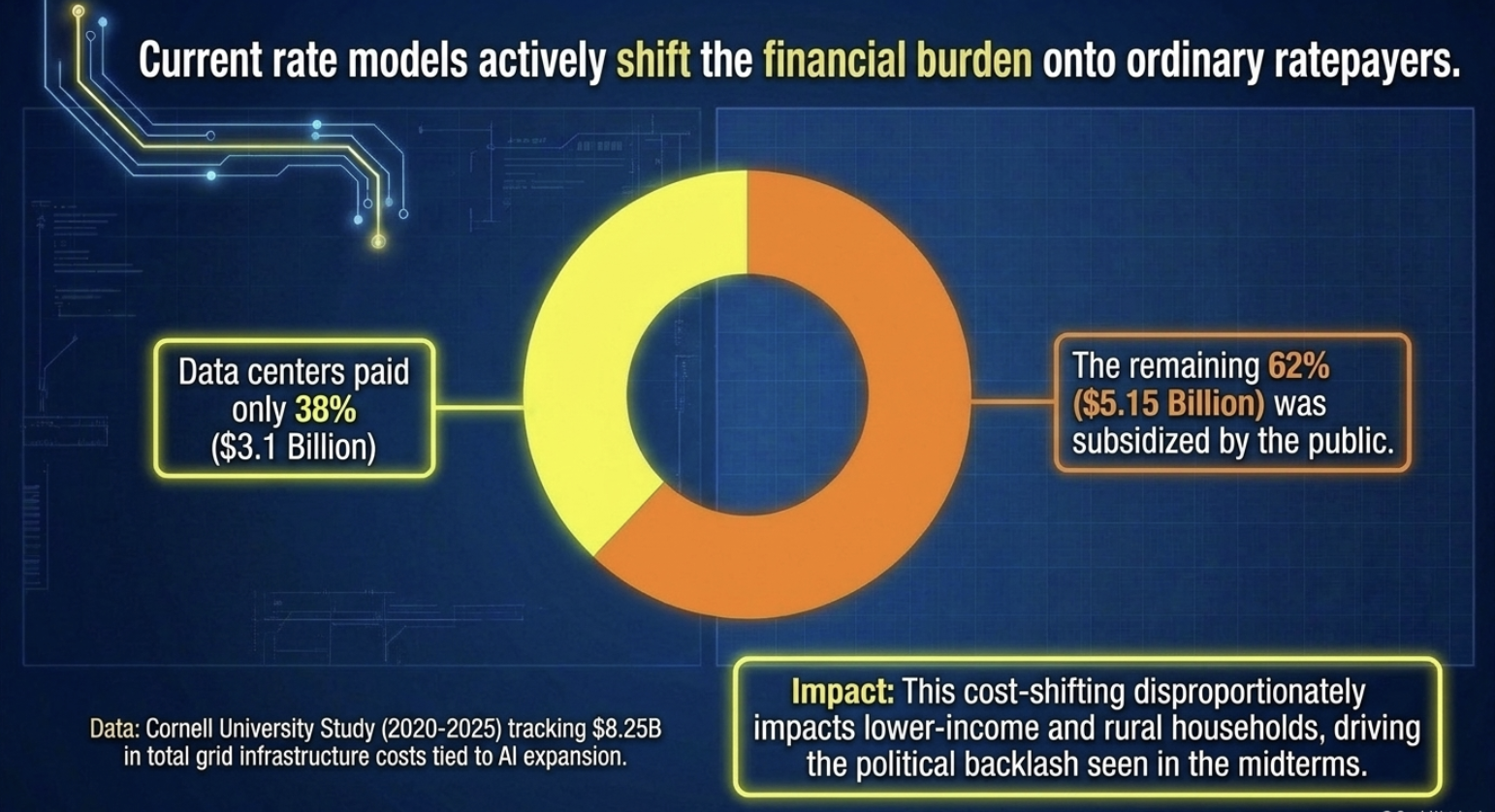
An analysis by Cornell University looked at four major U.S. power grids between the years of 2020 and 2025. According to the study, data centers paid only about 38% of the infrastructure costs related to their own expansion in 2025.
This amounts to about $3.1 billion out of an $8.25 billion total. The other portion fell largely on other customers.
Lower-income and rural households saw some of the largest increases relative to their incomes.
Special rate deals and large-load tariffs
To combat this, some states and utilities have started writing out new rules requiring very large customers, such as data centers, to cover more of the costs tied to their growth. These are often called special tariffs. Special tariffs require the customer to pay a minimum monthly charge, even if it uses less power than it reserved. It also requires them to post financial guarantees or collateral to pay an exit fee if it cancels or sharply reduces its demand before the end of the contract. For example, in Ohio, AEP's data center tariff requires customers above 25 MW to pay for at least 85% of their contracted demand. Similarly, in Virginia, Dominion Energy created a new rate class for customers of 25 MW or more. It includes minimum charges and long-term contract provisions.
The political reaction: bipartisan bills
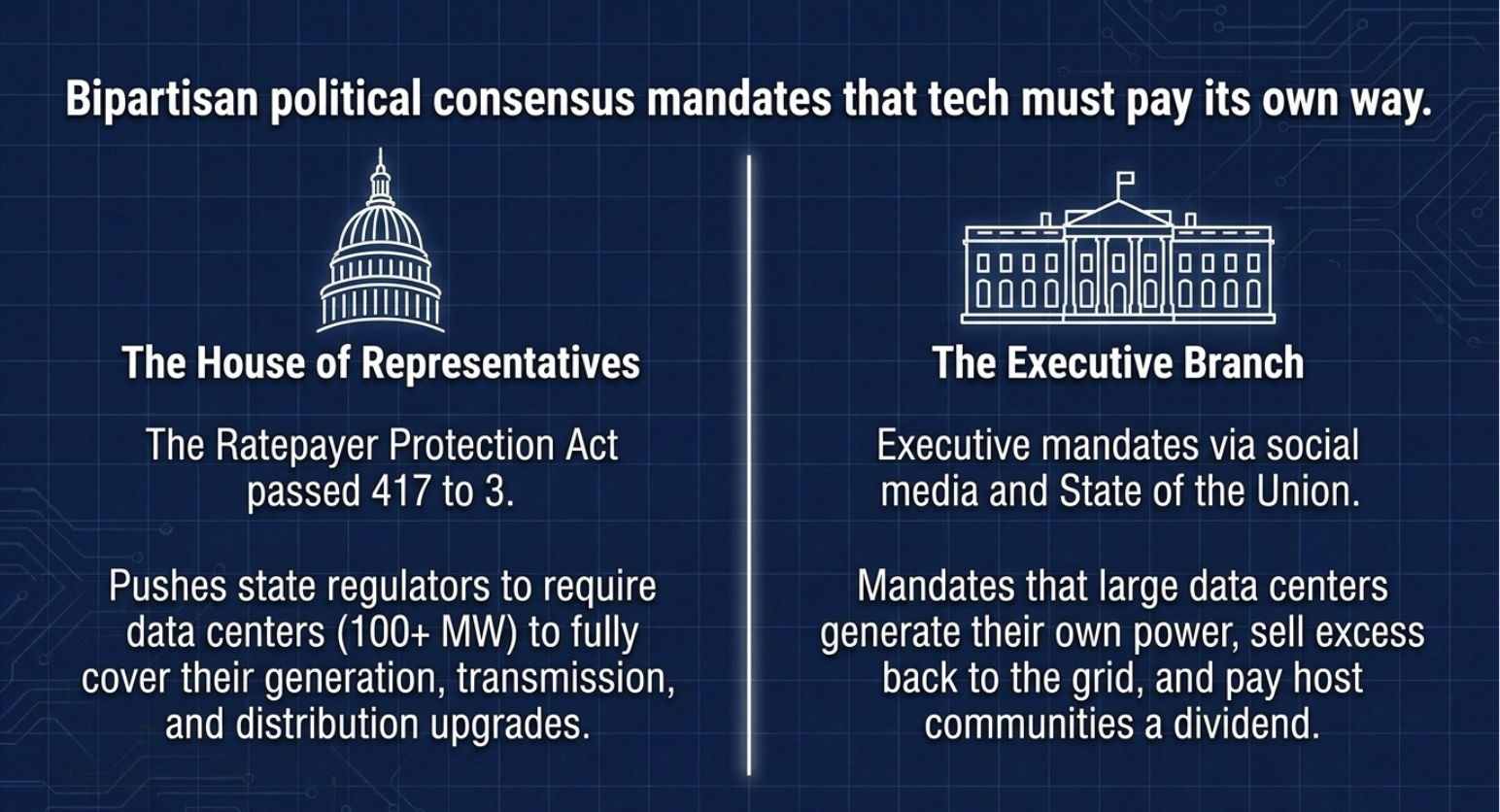
Politicians of all stripes have been recently concerned about ordinary customers paying for data centers' electricity. In September 2026, the U.S. House of Representatives passed the bipartisan Ratepayer Protection Act by a vote of 417 to 3. The bill requires state utility regulators to consider creating rules so that data centers of 100 MW or more would fully cover the cost of generation, transmission, and distribution upgrades needed to serve them. Critics, however, note that the bill lacks teeth, as it does not force states to adopt a standard. Some saw it as a political messaging bill, but it showed the full force of bipartisan agreement behind the issue.
Some states have moved further and faster on their own. Many utilities have received approval for special large load tariffs. In 2026, at least eight states passed laws that require regulators to make data centers pay their own way.
The practical constraints that slow “speed to power”
There are practical constraints that are slowing the ability of data centers to get utilities to build out the power that they need. One of the biggest limits is the long wait for equipment that produces and delivers electricity. Large natural gas turbines, which are the machines that create power at many new plants, are now booked well into the early 2030s. Average lead times in the U.S. are roughly 5 to 6 years. Major manufacturers are already taking orders for delivery in 2030 and 2031. Global orders have outrun factory capacity. Many developers who want power sooner are sometimes turning to used turbines or are converting engines from aircraft.
Other pieces of equipment faced similar delays. These backlogs mean that projects with financing and a site ready can still wait years for the hardware that they need to connect to the grid or to generate their own power.
Early operational problems
To combat these delays, some data centers are trying to generate their own power, but this is not without its own problems. Reliability and regulatory problems often stand in the way. In the Memphis area, for example, a major data center project has been using dozens of temporary trailer-mounted gas turbines while waiting for a permanent plant to be built out. Neighbors around the site have complained about noise and air quality. State regulators and the company have argued over whether the turbines needed full air permits. The problems go on and on.
Local opposition as a binding constraint
Voters have shown this year that they do not want large data centers in their communities. In the November elections, communities in ten states voted on more than 40 local measures related to data centers, and voters sided against the projects in all but one of them. Many of the measures banned or capped large facilities, imposed moratoriums, or required extra local approval.
Opposition to the campuses themselves has created a practical limit on the power projects needed to support them. A community that just voted to block or slow a data center is unlikely to welcome a new gas plant, high-voltage line, or substation. Even projects that propose to bring their own generation still need local permits, water, land, and new wires. The election results show that “not in my backyard” sentiment is already widespread, which makes it harder to site both the data centers and the energy infrastructure they require.
The policy landscape after the election
U.S. President Donald Trump has said on multiple occasions that new data centers should supply their own electricity rather than relying on the grid. In his 2026 State of the Union address, he described a ratepayer protection pledge under which major tech companies would build their own power plants. The idea, he said, was that companies would meet their own needs for electricity so that ordinary customers' bills would not go up and, in some cases, should even go down.
In a social media post on October 21 of this year, he returned to the same theme. He wrote on Truth Social that new and large data centers are mandated by him to make their own electricity and to give or sell any excess power back to the grid. He urged developers to pay host communities a dividend so that projects will become more popular with local residents. The administration has not implemented any binding rule or formal order following these statements, but they show that the White House wants developers to cover more of their own power costs and to share these benefits with the communities where the facilities are built.
What has (and has not) happened
In practice, the power to decide whether a data center must generate its own electricity rests mainly largely with individual states. State utility commissions and legislatures control retail service rules and the conditions under which a large customer can connect to the grid. Some states have already made it easier for data centers to build on-site or behind-the-meter generation, while others continue to rely on traditional utility service and large-load tariffs. The federal government can influence transmission and wholesale markets, but it cannot simply order every new data center to bring its own power plant as a condition of receiving electric service.
The incoming Democrat Congress
Democrats are set to take control of Congress in January. Expect a lot of oversight hearings about the issue of affordability. During their campaigns, many Democrat candidates argued that data centers should pay for their own power plants, transmission lines, and other infrastructure, rather than making ordinary ratepayers pay for it. Some Democratic members of the House have introduced or supported bills that would do just that.
Another area of focus under a Democrat Congress is environmental impacts. Data centers use a lot of water for cooling, and their gas turbines or diesel backup can pollute and increase local air emissions. The incoming Democrat leaders have expressed interest in hearings and legislation that would deal with these issues.
Industry response so far
A handful of the largest hyperscalers have said they will sign voluntary pledges to pay for their own data center energy and for the grid upgrades required to serve them. Some companies are building private gas plants, signing deals with nuclear power facilities, or combining behind-the-meter turbines with a smaller grid connection. It should be noted that these pledges are not binding rules, and often the details of what full cost covers can still be negotiated in each state or utility territory. The result is a patchwork of promises and various compromises.
The unresolved tension
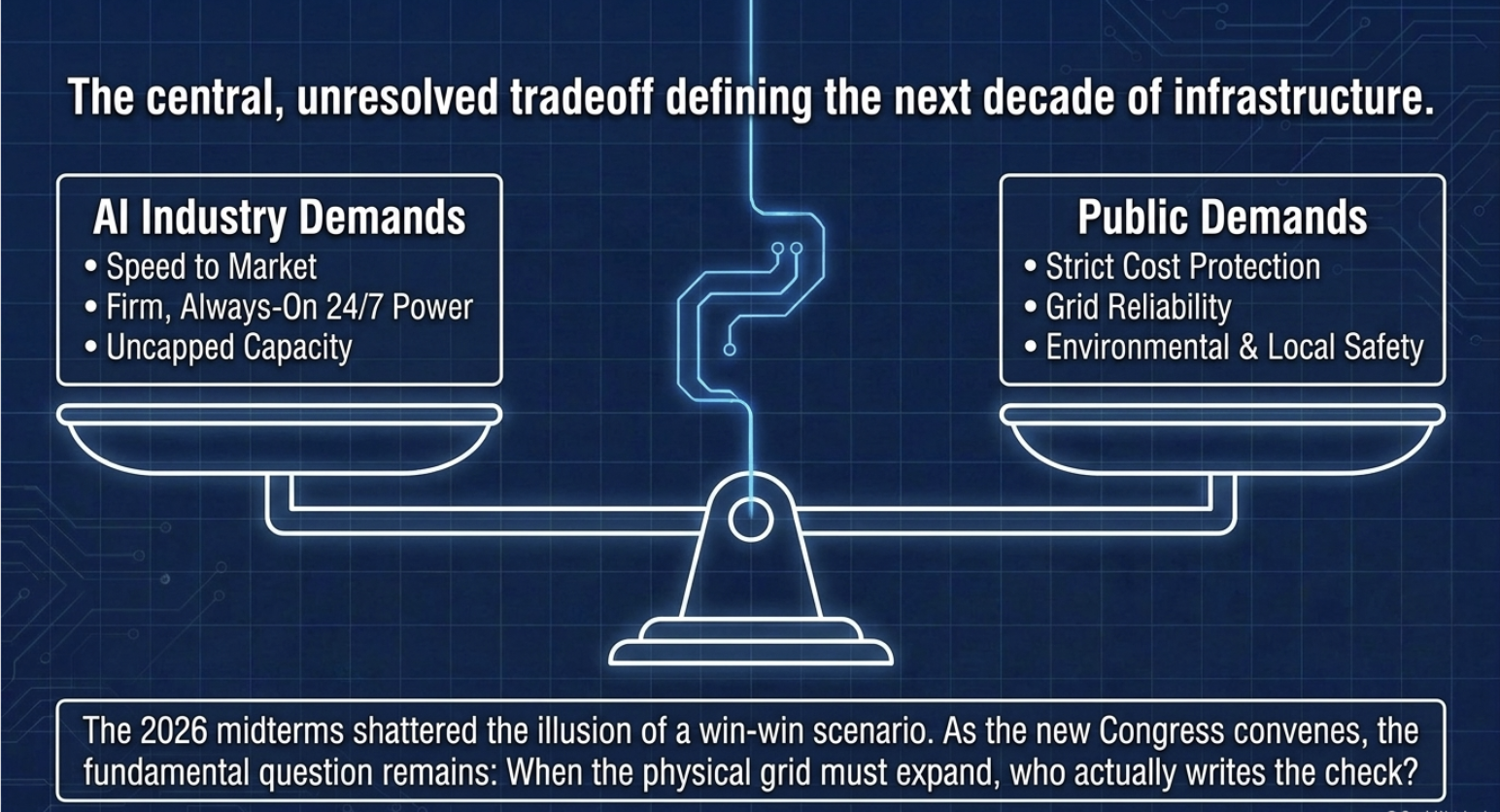
The basic tension is straightforward. The companies building large AI data centers want firm, always-on power as quickly as they can get it, so they can open new campuses and run their equipment around the clock. Ordinary ratepayers and nearby communities do not want to pay for the new power plants and power lines those campuses need, or take on the higher risk of outages and the local environmental effects that can come with rapid growth. That single tradeoff (speed for the industry versus cost and risk for everyone else) remains the core of the debate.
The midterm results have made that question harder to postpone. With Democrats taking control of Congress in January and with voters already rejecting data-center projects in most local measures, lawmakers and regulators are under more pressure to decide who should pay for the new generation, transmission, and local upgrades. States are still writing the large-load rules, the federal government has not turned the “bring your own power” idea into a binding requirement, and the voluntary pledges from the biggest technology companies have not settled the issue in every market.
That leaves the practical arguments still open: how fast the grid can expand, how costs should be assigned, and what happens when communities push back. Those are the questions the rest of this series will examine as the new Congress begins its work.