
Activist investing sounds complicated. It isn't. Here's the plain-English breakdown.
What is activist investing?
Activist investing is a strategy. A hedge fund buys a big chunk of stock in a public company. Not a controlling stake; just enough to force change.
The goal: boost the stock price by pressuring management. That's it.
A few things separate activist investors from other types of investors:
Not private equity. Private equity buys full or majority control. Activists rarely want outright ownership.
Minority stake, major leverage. They don't need control to make noise.
Public companies only. The target has to be publicly traded.
Activists have three main tools:
Persuasion
Public pressure
Shareholder votes

How the process usually plays out:
Step 1: The investor quietly builds a stake over time.
Step 2: Once that stake hits 5% of voting shares, federal law forces disclosure to the U.S. Securities and Exchange Commission. Now everyone knows who's buying and why.
Step 3: The investor publishes a detailed presentation diagnosing what's wrong with the company and prescribing fixes. Fixes typically mean:
Cost cuts
Divestitures
Sale of the whole company
Management shakeup
Step 4: The investor engages privately with the board and management first.
Step 5: If that stalls, they escalate to public campaigns, media pressure, open letters.
Step 6: If negotiation still fails, they launch a proxy contest to get their own people on the board.
Step 7: In extreme cases: litigation threats, a special shareholder meeting, or a consent solicitation to remove directors outright.
Most fights never make it past step 5 or 6. That's the point. Public pressure usually works.
What are proxy contests, and how do they work?
A proxy contest is a battle for control of the boardroom. Also called a "proxy fight" or "proxy battle." It gets decided at the ballot box, not in a courtroom.
Here's the setup: "dissident shareholders" try to gather enough proxy votes from other shareholders to replace board members, block a deal, or force strategic change.
Most shareholders skip the annual meeting. So they assign their voting rights to a proxy, and the dissidents fight to win those proxies over. One notable stat: proxy fights led by hedge funds now win 60% of the time.
The step-by-step process:
Dissidents identify the issue and decide what they want changed.
They nominate alternative board candidates, or draft resolutions.
They register with the SEC, usually 45 to 60 days before the shareholder meeting.
Their SEC paperwork discloses the nominees and the reasoning behind them.
They must commit to soliciting shareholders representing 67% of voting power. This is a "universal proxy" requirement.
All nominees (company and dissident) appear together on one ballot, listed alphabetically.
Both camps campaign through mailings, calls, meetings, solicitation forms, and media.
Votes get cast and counted at the annual (or special) meeting.
Many contests settle before a single vote is cast.
How your vote actually gets there, if you're a shareholder:
You don't hand your vote directly to the activist. The activist and the company both send you competing proxy materials.
You vote by card, online, or by phone. You pick whichever side's instructions you want to follow.
Most retail investors are "beneficial owners," meaning your broker holds the shares in "street name" while you hold the economic interest.
If you're a Non-Objecting Beneficial Owner (NOBO), the company can reach you directly.
If you're an Objecting Beneficial Owner (OBO), your broker keeps your identity private and relays materials on your behalf.
Either way, materials route through your bank or broker — never straight to you.
Activists typically hire a proxy solicitation firm to identify shareholders and reach them through mailings, calls, ads, and websites.
The universal proxy card matters here. Since 2022, the SEC requires a single card listing every nominee from both sides. Before that rule, remote voters had to pick one side's full card; no mixing and matching. Now you can vote for any combination of candidates, up to the number of open seats. You can even change your mind and resubmit; the newest card is the one that counts.

Recent examples where activist campaigns won without a vote ever being cast:
Norwegian Cruise Line: Elliott Management pushed for governance and strategy changes; the company added five independent directors.
Six Flags: JANA Partners pushed the company to explore a sale, which led to a new board chair.
Fortune Brands: Garden Investments demanded a new CEO succession plan; the company dropped its CEO candidate and added a Garden-affiliated director.
Warner Bros: Ancora Holdings Group's pressure helped push Paramount Skydance to raise its offer, resulting in the sale to Paramount.
The pattern: most of the real leverage comes before the vote. The threat of a fight is often enough.
Where do boards of directors fit in?
Boards sit at the center of all this. Shareholder activism shifts with market pressures, available capital, and whatever governance issue is trending. Directors are the ones who have to see it coming.
A few numbers worth knowing: activist campaigns hit a record high of 137 in the U.S. in 2022, dipped during the pandemic, and rebounded after the SEC's universal proxy rule. One of the top objectives of any activist campaign now centers on M&A — pushing a company to sell itself, sell parts of itself, or accept better deal terms.
What makes a company a target (the red flags activists look for):
Poor financial or share performance
Governance weaknesses
Environmental and social shortcomings
Ignoring shareholder concerns
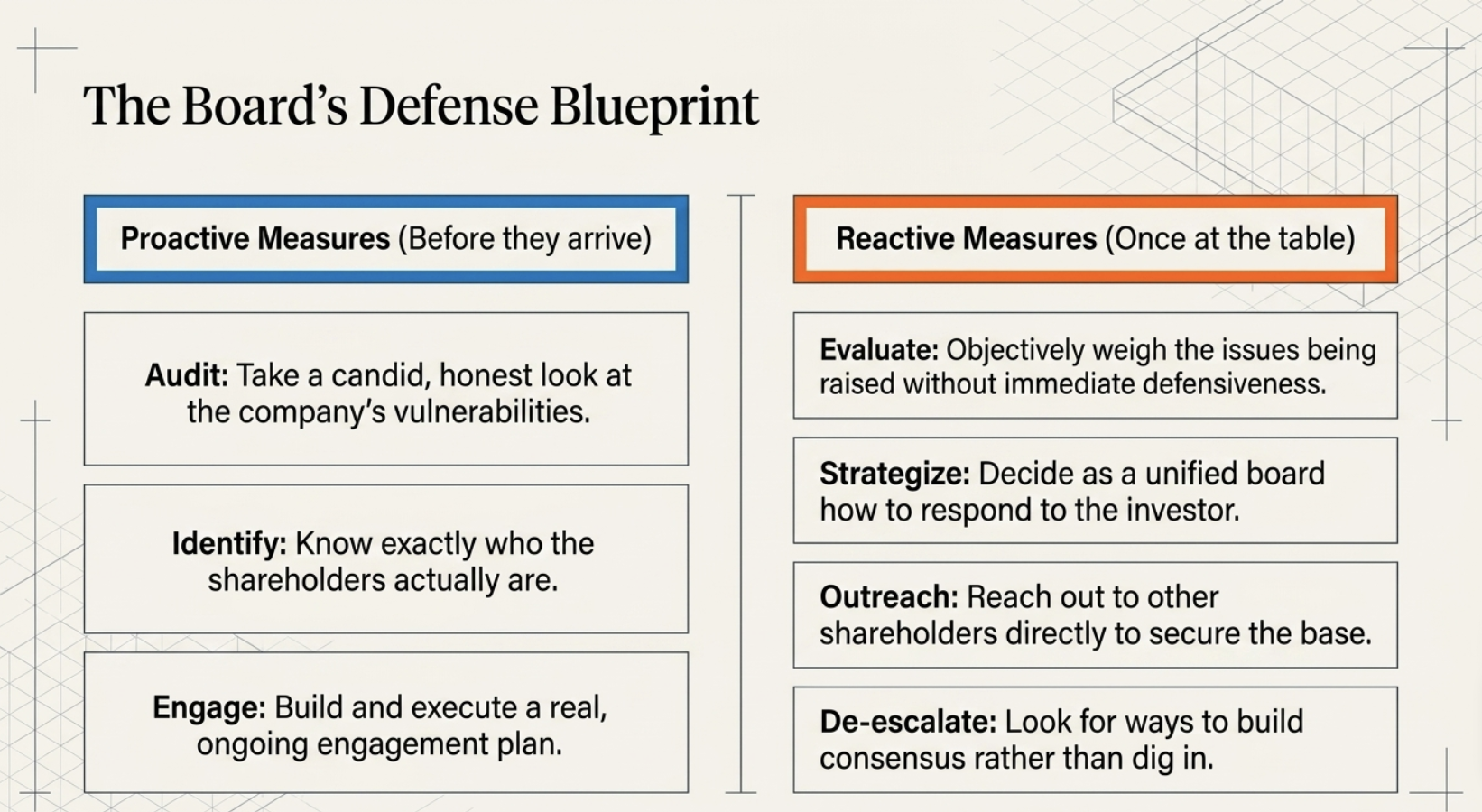
How boards get ahead of it, before an activist shows up:
Take a candid, honest look at the company
Know who the shareholders actually are
Build a real engagement plan
How boards respond once an activist is already at the table:
Objectively weigh the issues being raised
Decide how to respond to the investor
Reach out to other shareholders directly
Look for ways to build consensus rather than dig in

The bottom line: boards that ignore shareholders long enough eventually meet an activist. The ones that stay engaged early tend to avoid the fight altogether.
Activist investors rarely win by force. They win by making the board's silence look worse than their demands. Skip the phone call, and you'll get a proxy card instead. In this business, the cheapest defense is still just answering the mail.
Further reading
A Concise Guide to Activist Investing (PDF) (The Activist Investor)
Watch: Activist Investing 101: How it Works - YouTube video (The Vanguard Record channel)
Proxy Contest: Meaning, Process, Examples, and How It Works (Quantillium)
Shareholder Activism Developments in the 2025 Proxy Season (Harvard Law School Forum on Corporate Governance)
Shareholder activism surges to fresh highs (Barclays)
Understanding Dissenters' Rights: Key Insights for Shareholders (Investopedia)
What is an activist investor? (The Corporate Governance Institute)