Russ Vought's long game: the Center for Renewing America
Inside the small Washington operation that wrote the second Trump administration before it began.
By Shawn Geddes
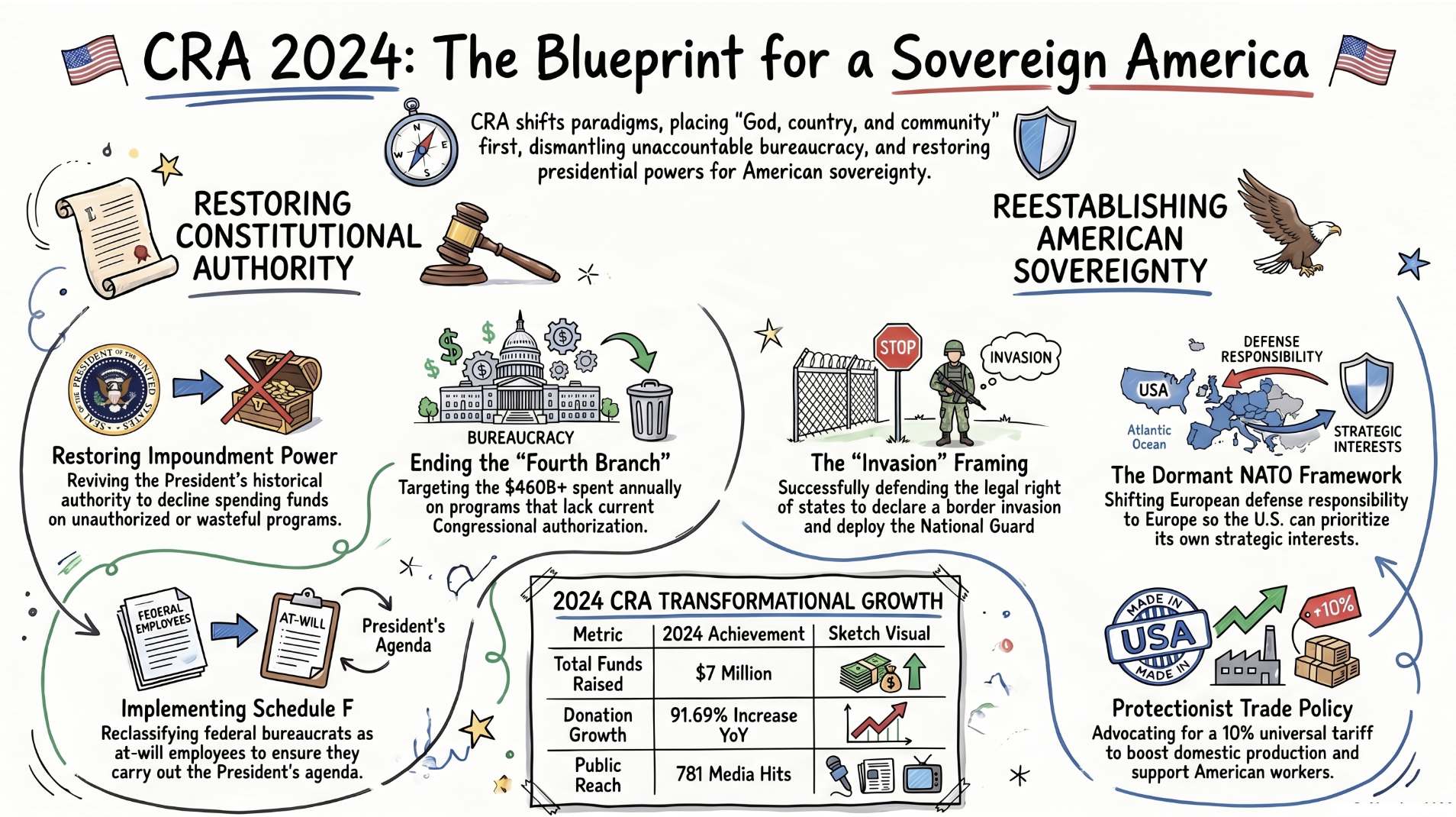
A Washington policy organization that spent four years methodically developing the intellectual framework for a second Trump administration has seen its ideas move from white papers to West Wing directives, with founder Russell Vought serving as President Donald J. Trump’s director of the Office of Management and Budget.
The Center for Renewing America, founded in 2021, capped a breakout year in 2024 with more than 780 media mentions, 194,000 website visitors and more than $606,000 in online donations; a roughly 92 percent increase over the previous year. The group's reach on X topped 6.4 million impressions.
By nearly every measure, during the 2024 election and during Trump’s first few months into his second term, the CRA emerged as one of the most consequential conservative policy shops in the country, supplying both the personnel and the playbook for the incoming administration.
From outsider to architect
Vought, who served as OMB director during Trump's first term, spent the interim years building what allies described as the most detailed governing blueprint any administration-in-waiting had ever assembled. Eric Teetsel, the group's vice president, took over as chief executive in 2025 as Vought returned to government.
Vought also served as policy director for the 2024 Republican National Convention's Platform Committee, an assignment that allowed the CRA to translate its core priorities (fair trade, secure borders, restrained foreign commitments) directly into the party's official platform.
The organization had identified five strategic priorities for 2025:
Restoring constitutional authority to the presidency
Securing the southern border
Ending what it calls a weaponized bureaucracy
Drawing down endless wars
Rebuilding an America First economy
Restoring the presidency
A signature project has been the center's work to revive presidential impoundment authority, the power of a president to decline to spend appropriated funds. In a widely cited book, center scholars Mark Paoletta and Daniel Shapiro documented how presidents routinely exercised the authority for nearly two centuries before the Impoundment Control Act of 1974 curtailed it.
Vought has called the 1974 law the "original sin" that stripped the executive branch of any meaningful check on runaway federal spending. Restoring impoundment, supporters argue, would give a president a long-dormant constitutional tool to rein in deficits without waiting for a fractured Congress to act.
The center has also championed "Schedule F," a reform that would reclassify federal employees involved in policy work as at-will, making it easier to remove career staff who refuse to implement an elected president's agenda.
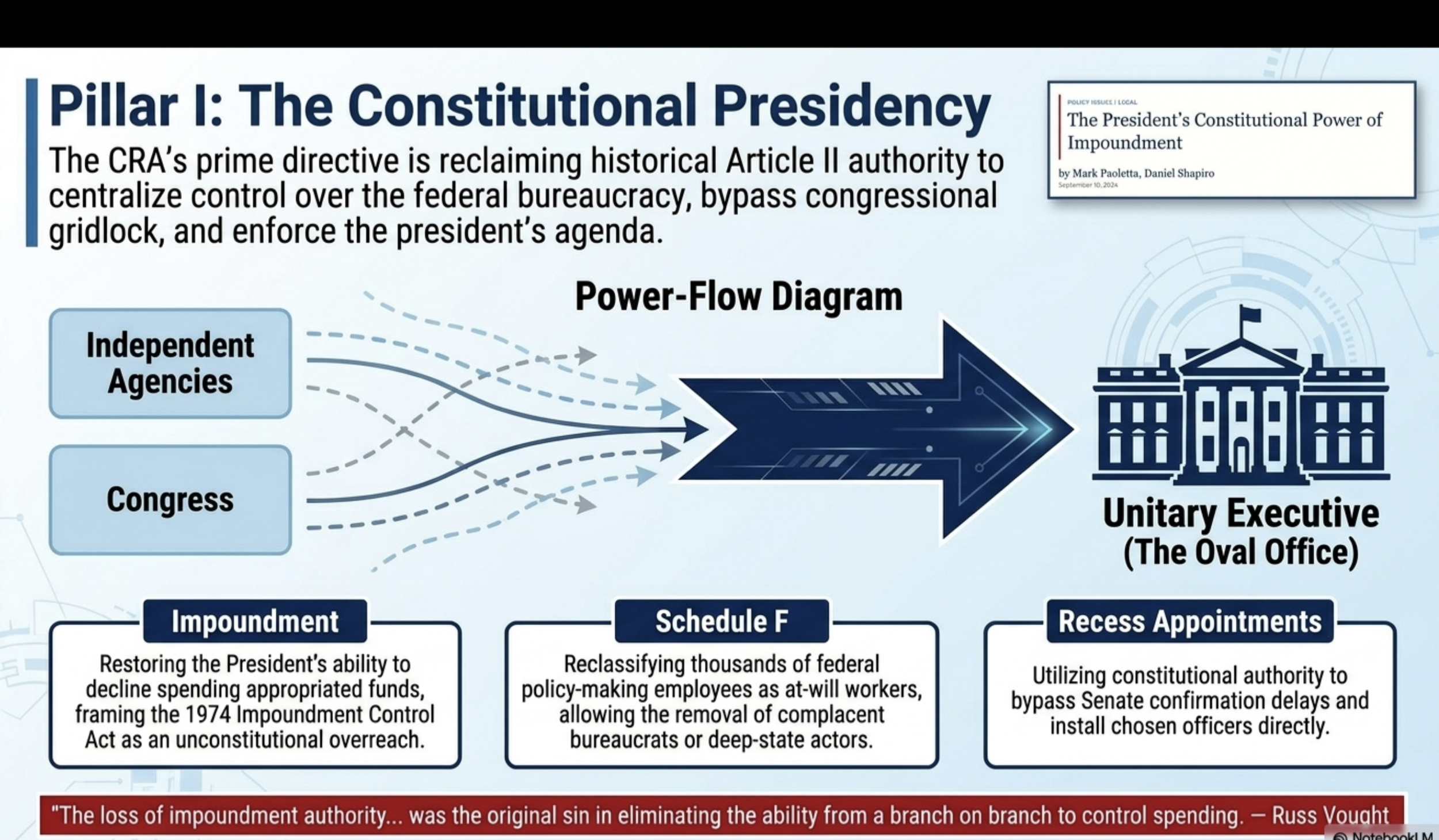
Supporters see it as a long-overdue accountability measure for an executive branch that voters, not bureaucrats, are entitled to direct.
A legal framework for the border
The CRA has done some of its most influential work on immigration, advancing a constitutional argument that states may invoke Article I, Section 10 to respond to an "invasion" when the federal government will not act. The theory, developed by senior fellow Ken Cuccinelli, a former acting deputy secretary of homeland security, provided the legal foundation for Texas Gov. Greg Abbott's deployment of river buoys along the Rio Grande.
The 5th U.S. Circuit Court of Appeals ultimately allowed the barriers to remain, a ruling the center views as vindication of its framework.
Center scholars have also documented the scale of the border crisis, pointing to more than 10 million illegal entries during the Biden years, and have argued that restoring sovereignty will require mass deportations alongside renewed enforcement at the line.
A new trade consensus
On economic policy, the center has helped build the case for a universal 10 percent tariff on imports, a proposal once considered heterodox that is now mainstream Republican thinking. Center scholars, including Micah Meadowcroft, have argued that tariffs do not end trade but reshape it to favor American producers, raise the competitiveness of domestic manufacturing and prompt new investment in American communities hollowed out by decades of offshoring.
The organization's economic work reflects a broader argument: that the bipartisan Washington consensus on free trade enriched geopolitical rivals, particularly China, while leaving American workers behind.
Rethinking America's role abroad
The CRA’s foreign policy work centers on what senior fellow Sumantra Maitra has called a "Dormant NATO" — an alliance returned to its original defensive purpose, with European nations finally shouldering primary responsibility for their own security. The framework calls for "strategic burden shifting" rather than open-ended American commitments.
Maitra has also outlined a pragmatic path out of the war in Ukraine, proposing direct negotiations, frozen front lines, demilitarized buffer zones and guaranteed Ukrainian neutrality. The proposal reflects the center's broader skepticism of forever wars and its preference for restraint and realism in American foreign policy.
Reining in an unaccountable bureaucracy
The Center for Renewing America has built a detailed case that much of the federal government now operates on autopilot, with major agencies running on authorizations that expired years or even decades ago. The National Institutes of Health has not been comprehensively reauthorized since 2007, the Department of Justice since 2003, and the Centers for Disease Control and Prevention, the center notes, has never received a full authorization at all.
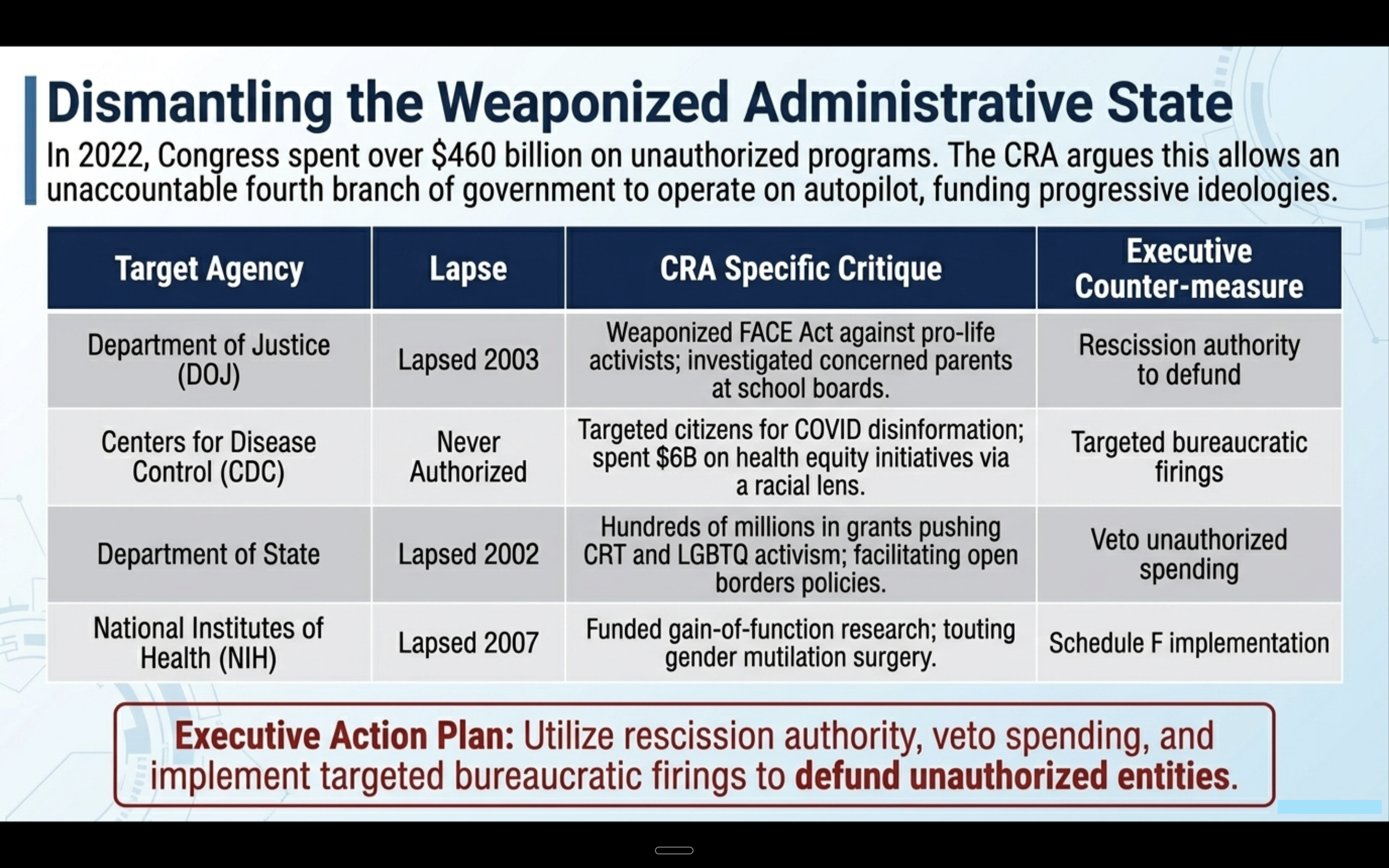
The result, the group argues, is a sprawling administrative state that answers to no one: pursuing ideological agendas on diversity, climate and public health without meaningful congressional oversight. Among its targets for reform were the U.S. Agency for International Development, the Department of Education and the Consumer Financial Protection Bureau.
Grassroots reach
The center's sister advocacy arm, Citizens for Renewing America, has translated policy work into legislative wins at the state level.
Its model legislation requiring age verification on social media and pornography websites has been adopted in multiple states; CNN has credited the framework with prompting Pornhub to block access in more than a dozen states rather than comply with the new protections for minors.
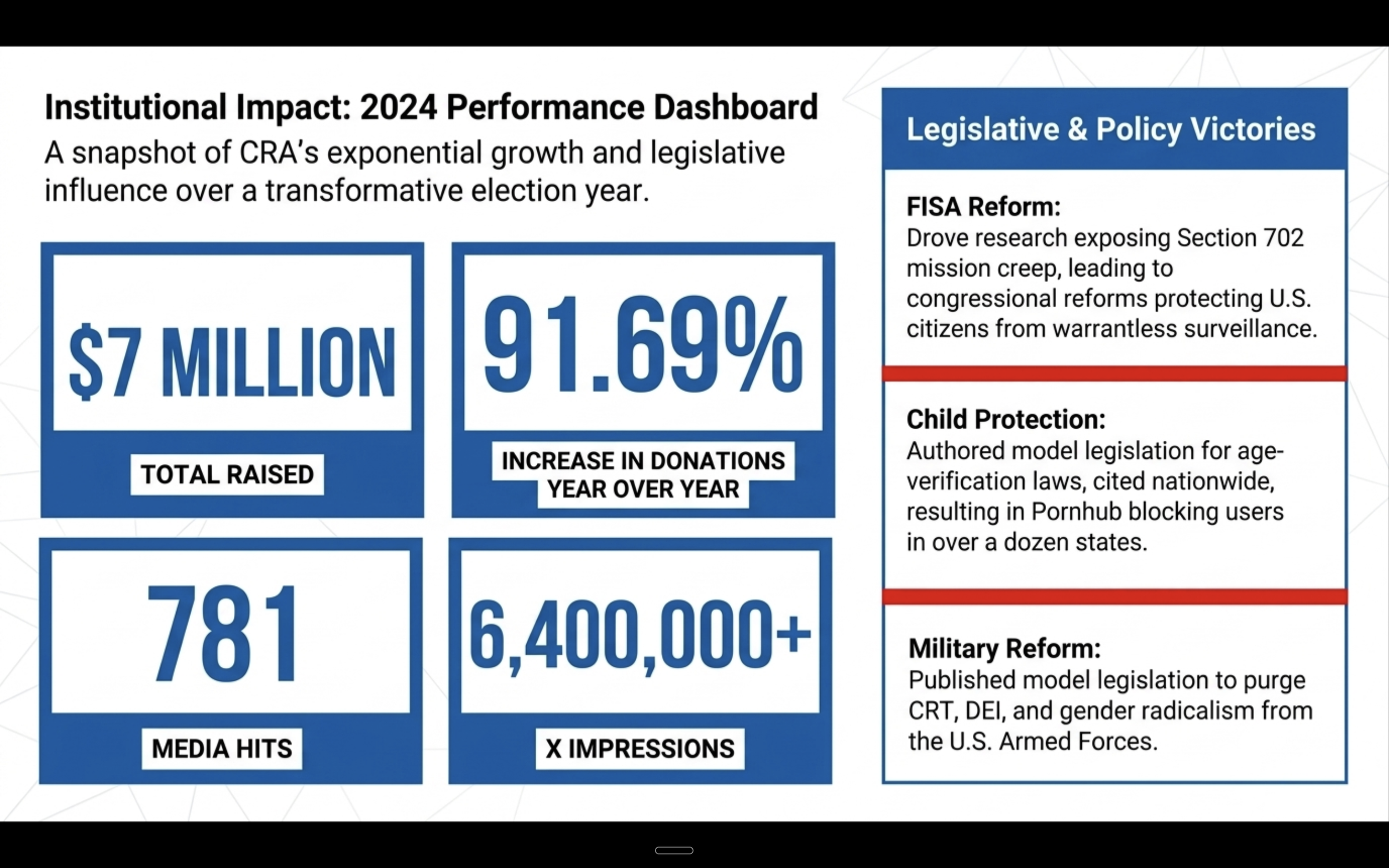
In March 2024, the organization released "Vehicles for Restoring the United States Armed Forces," a detailed guide for removing critical race theory, DEI programs and gender ideology from the military to restore focus on combat readiness.
A movement coming into its own
With Vought now running OMB, the center's policy infrastructure has shaped decisions across the federal government, from budget enforcement to civil service reform to trade strategy. Allies note that few think tanks have ever entered a new administration with so much of their work already adopted as official policy.
For an organization that began years ago as a small operation pushing ideas many in Washington considered impossible, the moment marked an extraordinary arrival.
Further reading
2025 Annual Report (Center for Renewing America)
CRA Files an Amicus Brief to the Supreme Court of the United States supporting President Trump’s Argument to End Birthright Citizenship for the Children of Illegal Immigrants (Center for Renewing America)
Exposing the Woke, Wasteful, and Bloated Bureaucracy (House Budget Committee)
“Meet the Trump Budget Hawk Partnering With Musk’s DOGE” (Wall Street Journal)
Model Legislation for Age Verification of Social Media (Citizens for Renewing America)
Policy Brief: Pivoting the US Away from Europe to a Dormant NATO (Center for Renewing America)
Primer: The Road Back from War in Ukraine (Center for Renewing America)
“Russ Vought, champion of Schedule F and slashing agency budgets, wins confirmation to OMB” (Government Executive)
Schedule F: The Phantom Menace (Cato Institute)
Statement by President-elect Donald J. Trump Announcing the Nomination of Russell Thurlow Vought as Director of the United States Office of Management and Budget (OMB) (The Presidency Project)