Jury awards $5.5 million to Atlanta security guard who recorded her own assault
This story is part 1 of a Vanguard Record series on sexual harassment lawsuits
A federal verdict against a private security firm and its vice president of operations details a pattern of harassment, physical assault, and retaliation — capped by the theft of evidence containing a message from a deceased loved one.
Makita Bryant took the job as a security guard at C&M Defense Group believing she was building a career. What she encountered instead, according to federal court proceedings, was a supervisor who treated her as a target.
Charles Reedy, Jr., the company's vice president of operations, began subjecting Bryant to persistent sexual harassment in 2022. The conduct was pervasive: unwanted sexual comments, pressure to engage in sexual acts, repeated invitations to accompany him to a hotel and a strip club. He offered her financial favors and a promotion in exchange for sex.
When Bryant refused, the situation escalated beyond words. At a worksite, Reedy pushed her against a wall, groped her, and exposed himself by unzipping his pants.
Bryant did not simply absorb the abuse. She came prepared. Using a personal recording device, she captured audio evidence of one of the physical assaults . . . a recording that would later anchor a federal lawsuit and become the subject of a legal dispute in its own right.
Reported, then punished
Bryant brought her evidence directly to C&M Defense Group's owner, CEO, and field support manager, handing over the recording device as proof of what had happened to her. The company's response was to do nothing. No investigation, no disciplinary action against Reedy, no remedy of any kind.
Instead, what followed was retaliation. The company stopped assigning Bryant shifts. Then it reassigned her to a job site with hours it knew she could not work, a maneuver that effectively ended her employment. She was, in all but formal terms, terminated in July 2023.
The company also refused to return her recording device. That detail would carry unexpected weight in the proceedings: the device contained not only the evidence of her assault, but a personal voice message from a deceased loved one, a loss Bryant described as deeply sentimental.
The EEOC steps in
Bryant filed a complaint with the U.S. Equal Employment Opportunity Commission, the federal agency charged with enforcing workplace discrimination law. In May 2024, the EEOC issued a Letter of Determination concluding there was reasonable cause to believe C&M Defense Group (which by that point had rebranded as Global Security Management Team, LLC) had violated Title VII of the Civil Rights Act of 1964.
The agency found the company had subjected Bryant to a hostile work environment and discharged her in retaliation for reporting the abuse. Pre-litigation settlement discussions broke down, and the EEOC filed a federal lawsuit in the U.S. District Court for the Northern District of Georgia.
Missing evidence, and a court's instruction to assume the worst
During the legal proceedings, another damaging fact surfaced: the company had failed to preserve text messages exchanged between its vice president, chief operating officer, and vice president of operations. The court responded by instructing the jury that it was entitled to assume the destroyed evidence would have been unfavorable to the defense — a so-called spoliation instruction that can be devastating in a jury's deliberations.
The instruction effectively told jurors that the company not only mistreated Bryant, but took steps (whether negligent or deliberate) to prevent the full record from coming to light.
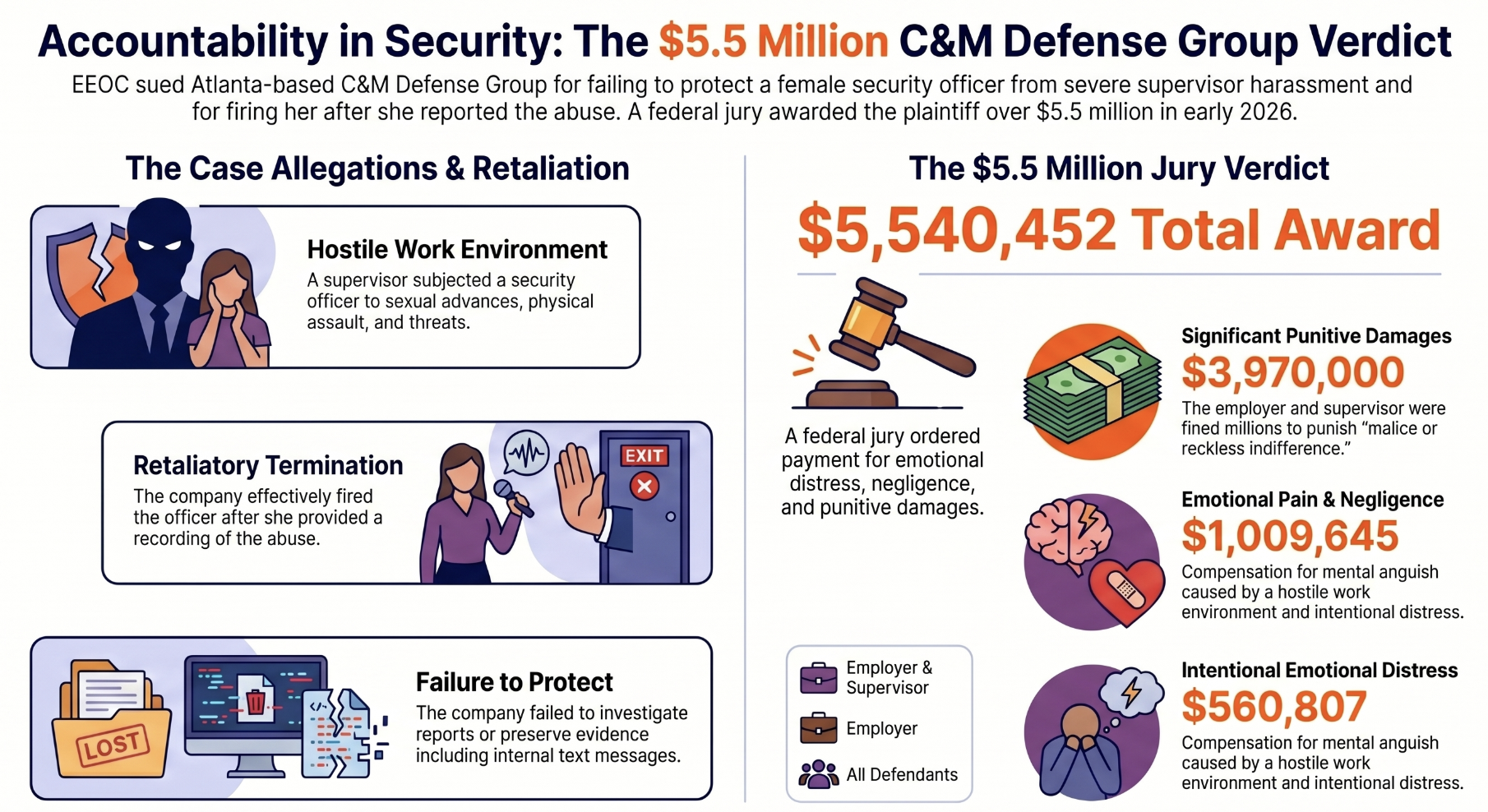
The verdict: $5.5 million
In January 2026, a federal jury ruled in Bryant's favor, finding that the defendants had acted with malice or reckless indifference toward her rights.
The total award came to $5,540,452, assessed against both the corporate defendants and Reedy personally.
The damages were broken down across several categories. The corporate entities were held liable for approximately $1 million in compensation for emotional pain and mental anguish caused by the hostile work environment, discrimination, and retaliation.
All defendants together were ordered to pay roughly $560,000 for intentional infliction of emotional distress, and $10,000 specifically for the wrongful retention of Bryant's recording device.
The largest portion of the award came in punitive damages ($3.96 million in total) designed not merely to compensate Bryant, but to punish the defendants and deter similar conduct. The corporate defendants were assessed $2.21 million in punitive damages, covering negligence, the hostile work environment, her wrongful termination, and intentional infliction of emotional distress.
Reedy personally was ordered to pay $1.75 million in punitive damages: $1 million for his intentional infliction of emotional distress, and $750,000 for his role in the conversion of Bryant's property.
A case built around accountability
To determine that punitive damages were warranted, the jury was asked to weigh whether C&M had engaged in a pattern of discrimination, whether it acted malevolently or with blatant disregard for its legal obligations, and whether it had failed to investigate complaints and take corrective action. The evidence, the jury found, answered those questions decisively.
For Bryant, the verdict closes a chapter that began when she was an ordinary employee trying to do her job and ended with a federal jury holding her employer and supervisor accountable for one of the more thoroughly documented workplace harassment cases in recent memory.
C&M Defense Group now operates under the name Global Security Management Team, LLC.
This article is based on publicly available federal court records and EEOC proceedings in the matter of Makita Bryant v. C&M Defense Group, LLC, Charles Reedy, Jr., and Global Security Management Team, LLC, U.S. District Court for the Northern District of Georgia.
Additional sources
https://www.eeoc.gov/newsroom/eeoc-sues-cm-defense-group-sexual-harassment-and-retaliation
PDF of the judgment: https://assets.alm.com/5e/c7/f61a7e654a55bd468f771b617bab/bryant-v-c-m-defense-judgment.pdf