A punchline like a trapdoor: the strange genius of PBF
The first dead child arrives with a rainbow halo and a speech bubble that simply reads, “Neat.” In the next panel, an angel’s face melts into horror. In the final frame, everything—clouds, harp, halo—erupts in ash. Somewhere between the second and third panel, a reader on a lunch break in 2004 lets out a startled bark of laughter, then glances around the office to make sure no one saw. They have just fallen into the world of The Perry Bible Fellowship, the internet comic strip that turned the web’s infinite scroll into a series of tiny existential trapdoors—and quietly rewrote what an online gag strip could be.
When The Perry Bible Fellowship, better known by the shorthand PBF Comics, began running in Syracuse University’s student newspaper The Daily Orange in 2001, it looked, at first glance, like any other college strip. There were three or four panels, a neat grid, pastel colors and doodled faces. But inside those boxes, the creator, a soft‑spoken film student named Nicholas Gurewitch, was staging something closer to an ambush than a joke. Unicorns were decapitated mid-gallop, astronauts learned that God was indifferent, and children discovered that the universe was, on balance, not on their side. By the time the strip migrated online a few years later, “PBF” had become a kind of secret handshake among early webcomics readers: if you knew it, you knew the internet was capable of more than cats and clip art.
Gurewitch did not set out to start a webcomic empire. He and friends Albert Birney and Evan Keogh launched The Perry Bible Fellowship as a campus project, borrowing its name from a church in Maine whose sign he’d once driven past and found inexplicably funny. The strip ran in The Daily Orange and other college papers, where its Sunday placement made the ecclesiastical title feel like a small prank on the comics page itself. What distinguished PBF even then was its stylistic restlessness: one strip might resemble a children’s picture book with soft watercolors and round-headed toddlers; the next, a scratchy horror etching in the style of Edward Gorey. The effect was disorienting in print, but when the comics began to circulate online as jpegs passed from inbox to inbox, that constant shifting of tone and texture turned into part of the thrill.
The formal move that made PBF into an internet phenomenon was almost incidental: in October 2004, an early version of the strip appeared on a site run by a friend, and, in August 2006, Gurewitch launched pbfcomics.com as its official home. Suddenly, each new strip was not just pegged to a campus print schedule but beamed, instantly, into message boards, LiveJournal feeds, and office email chains around the world. Readers encountered it the way they encountered much of the early web: half-accidentally, via a link from a friend who promised, “You have to see this one.” A comic titled “Stiff Breeze,” the first on the official site, set the tone: a pastoral scene of two men on a hilltop gives way, in its final panel, to a cosmic punchline that collapses the distance between the personal and the planetary. It felt both throwaway and weirdly permanent, a tiny, shareable artifact that lodged in the brain.
In an era when most webcomics were scrappy, horizontal strips about gaming or geek culture, PBF’s pages looked luxuriant. Gurewitch treated each installment less like another entry in a series than like an individual painting with a joke attached. He toggled between “very simplistic and cartoonish” linework and “incredibly detailed” illustrations reminiscent of underground cartoonists like Tony Millionaire, as one critic put it. The humor, too, refused to stay put. One week, he would anthropomorphize a toaster or a bean bag chair; another, he would stage a theological dispute between God and a telemarketer. The only constant was the final-panel betrayal: what TV Tropes would later catalog as “mood whiplash,” a syrupy setup detonated by a last image of violence, despair, or grotesque misunderstanding.
That whiplash became PBF’s signature move, and its most imitated trait. “Black comedy” and “bloody hilarious” are the terms fans and catalogers reach for, but the strip’s darkness is less about shock than precision. A typical comic might open on a smiling child, a puppy, or an anthropomorphic planet, then pivot toward some quiet horror—a misunderstanding that leads to dismemberment, a romantic gesture misread as a threat, a scientific breakthrough that leaves humanity obsolete. The joke lands not because blood sprays across the panel, but because the violence exposes an emotional truth: that cheerful surfaces can conceal indifference, that good intentions often go unrewarded, that the cosmos has no obligation to be kind. The Verge would later describe PBF as a series of “subtle but devastating punchlines that reveal a heartbreaking truth about the world,” which may be the closest anyone has come to explaining why readers kept returning to a comic that so often left its characters worse off than it found them.
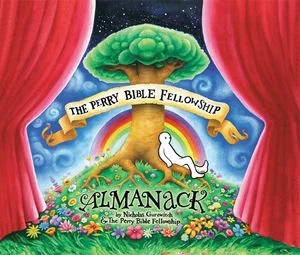
The internet may have made PBF famous, but its creator remained stubbornly analog. While other webcartoonists rushed to monetize with banner ads and merchandise lines, Gurewitch kept the site spare and the update schedule relatively modest. His real concessions to commerce came in print. In 2007, Dark Horse Comics published The Trial of Colonel Sweeto and Other Stories, a lavish collection of strips that, thanks to pre-orders alone, became one of the fastest-selling graphic novels on Amazon and forced the publisher to expand its initial print run to 36,000 copies. British distributor Diamond UK placed one of the largest orders Dark Horse had ever seen from across the Atlantic, signaling that PBF’s audience was as global in bookstores as it was in browsers. A follow-up volume, The Perry Bible Fellowship Almanack, would arrive with an introduction by Juno screenwriter Diablo Cody and eventually grow into a comprehensive, 256‑page compendium of Gurewitch’s work, including unused strips and pages of commentary.
By 2006, PBF had done something that few webcomics at the time even attempted: it jumped from the browser to the newsstand. The strip was syndicated in The Guardian, the British edition of Maxim, The New York Press, Boston’s Weekly Dig, The Portland Mercury, and Baltimore City Paper; by 2007, it was running in The Chicago Reader as well. In interviews from that period, Gurewitch noted that he was able to make a living from PBF, a rare feat for a gag‑a‑day cartoonist whose primary distribution channel was still the free web. But the success brought its own anxieties. To keep up with demand, he was producing a weekly strip, juggling deadlines from multiple papers, and fielding offers for animation projects and television pilots, including one with Comedy Central and another with the BBC. What had begun as a joyful side project now looked suspiciously like a career.
In February 2008, at what looked like the height of his momentum, Gurewitch stepped off the treadmill. In a short announcement, he told readers he was “cutting back” on the strip and moving it into what he later called “semi-retirement.” “I’m making this decision for a variety of reasons, but mainly because I want to do other things besides be a cartoonist,” he explained. The hiatus, which Know Your Meme would mark as an indefinite pause, stunned fans, syndicate editors, and peers alike. Other cartoonists, including those who had been inspired by PBF’s blend of sweetness and cruelty, read the move as a cautionary tale about success: a reminder that the very attention the internet lavishes on its favorites can make them feel trapped inside their own brands.
In the years since, PBF has existed in a kind of quantum state: not dead, exactly, but not quite alive either. The official site still updates, but only “irregularly,” as one observer put it, with new strips appearing months or even years apart. When they do, the internet reacts like a long‑abandoned fanclub receiving a dispatch from its founder: posts ripple through Reddit threads where users confess they have been checking the site “for like two years after the last one,” or admit that they still reload it out of habit. Some commenters say they are glad Gurewitch stopped when he did, arguing that the strip’s compressed body of work feels purer for its brevity, unsullied by the long, slow decline that has haunted many newspaper comics. Others continue to hope that an irregular schedule may someday become a regular one again.
For Gurewitch, the hiatus was less an ending than a rebalancing. He has spent the intervening years working on other books with Dark Horse, drafting a feature‑length screenplay he once described as his long‑gestating dream project, and collaborating on television pilots and animated adaptations of selected strips. In a 2020 interview, he talked about the allure and danger of success—that it can be “like addiction,” encouraging artists to repeat themselves, to stick with what is reliably rewarded rather than pursue stranger, less bankable ideas. PBF, in his telling, was both a breakthrough and a limitation: a form he could return to “at any point” in his life, but not the sum of his ambitions. “The thing is, I can always do comics,” he said. “At any point in my life.” The creative problem, then, was how to step away without losing the sense of play that had made those comics worth doing in the first place.
Whatever its future, PBF’s influence is already baked into the architecture of internet humor. Dozens of younger cartoonists now cite the strip as a formative inspiration, crediting it with showing that a four-panel gag could accommodate lush art, philosophical bite, and unapologetically bleak punchlines. The “Art Shift” between strips—a jump from stick figures to Baroque crosshatching—has become a standard trick among webcomics that treat style itself as part of the joke. So has the tonal lurch from saccharine to savage. Memes have grown up around individual PBF panels, detached from their original context and weaponized as reaction images: a unicorn obliterated in a beam of light, a beaming child moments before catastrophe, a planetary body betrayed by its own creators. Many readers who have never visited pbfcomics.com may still have absorbed its sensibility via screenshots and remixes in their social feeds.
The critical establishment has learned to take that sensibility seriously. The strip has won an Eisner Award, two Ignatz Awards, and three Harvey Awards, placing it on the same podium as the graphic novelists and alternative cartoonists whose books fill the shelves of independent bookstores. Reviewers have described it as a “twisted blending of the cute and profane” in which “a lot of its humor involves violence, but the horror is tempered with a gentle, sweet tone.” Others have praised Gurewitch’s ability to “seamlessly match hand-drawn artistry with subtle but devastating punchlines,” arguing that his best strips rank among the finest four‑panel gags in any medium, not just online. Even critics who worry that the formula—three panels of setup, one of brutal reversal—can eventually blunt its own edge concede that, at his peak, “it’s hard to think of anyone who’s better in webcomics.”
There is a strip, beloved enough to top the print-sales charts for PBF posters, in which a man proudly shows off a novelty T‑shirt emblazoned with a majestic unicorn. Over the course of a few panels, the image and the man’s reality fold into each other with disastrous results, leaving readers with a punchline that is equal parts absurd and tragically inevitable. It is, in miniature, a story about what happens when fantasy collides with the world’s blunt mechanics—a theme that runs quietly beneath the gore and giggles of much of Gurewitch’s work. The Perry Bible Fellowship turned that collision into a weekly ritual, inviting readers to step into a beautifully drawn illusion and, one panel later, to watch it collapse. More than two decades after its debut in a student newspaper, those tiny collapses still echo across the internet, their punchlines resurfacing in timelines and chat threads, reminding anyone who clicks that, online as in life, the sweetest setups sometimes hide the sharpest falls.
Further reading
PBF Comics on Wikipedia
Official website
“Artist Nicholas Gurewitch Discusses Scrapped Comic Ideas For ‘The Perry Bible Fellowship’ In Honor Of 10-Year Anniversary Almanack”. Forbes Magazine (2/6/20)
“Interview: Nicholas Gurewitch on ‘Perry Bible Fellowship’”. ComicMix (4/4/08)